
Artificial Intelligence and Adaptive Learning: A Roadmap for Instructional Leaders
AI can help schools personalize instruction and reduce some teacher workload. The key is to use it in ways that strengthen student thinking, protect privacy, and keep educators in the decision-making role.
Artificial intelligence is changing how schools plan instruction, respond to student needs, and manage teachers’ work. But the most important question for district and school leaders is not simply whether to use AI. It is whether that use helps students learn, think, and work more independently.
The evidence offers both promise and caution. Teachers report saving time with AI, and research points to benefits from some carefully designed instructional supports. At the same time, students who rely on AI-generated answers may perform well while the tool is available but struggle to demonstrate what they know on their own.
For instructional leaders, the work is to define the learning need, select an appropriate tool, prepare teachers and students, protect student information, and measure learning beyond the platform.
Start by understanding what the tool does
“AI in education” can describe several different functions. These tools may overlap, but they do not all serve the same instructional purpose.
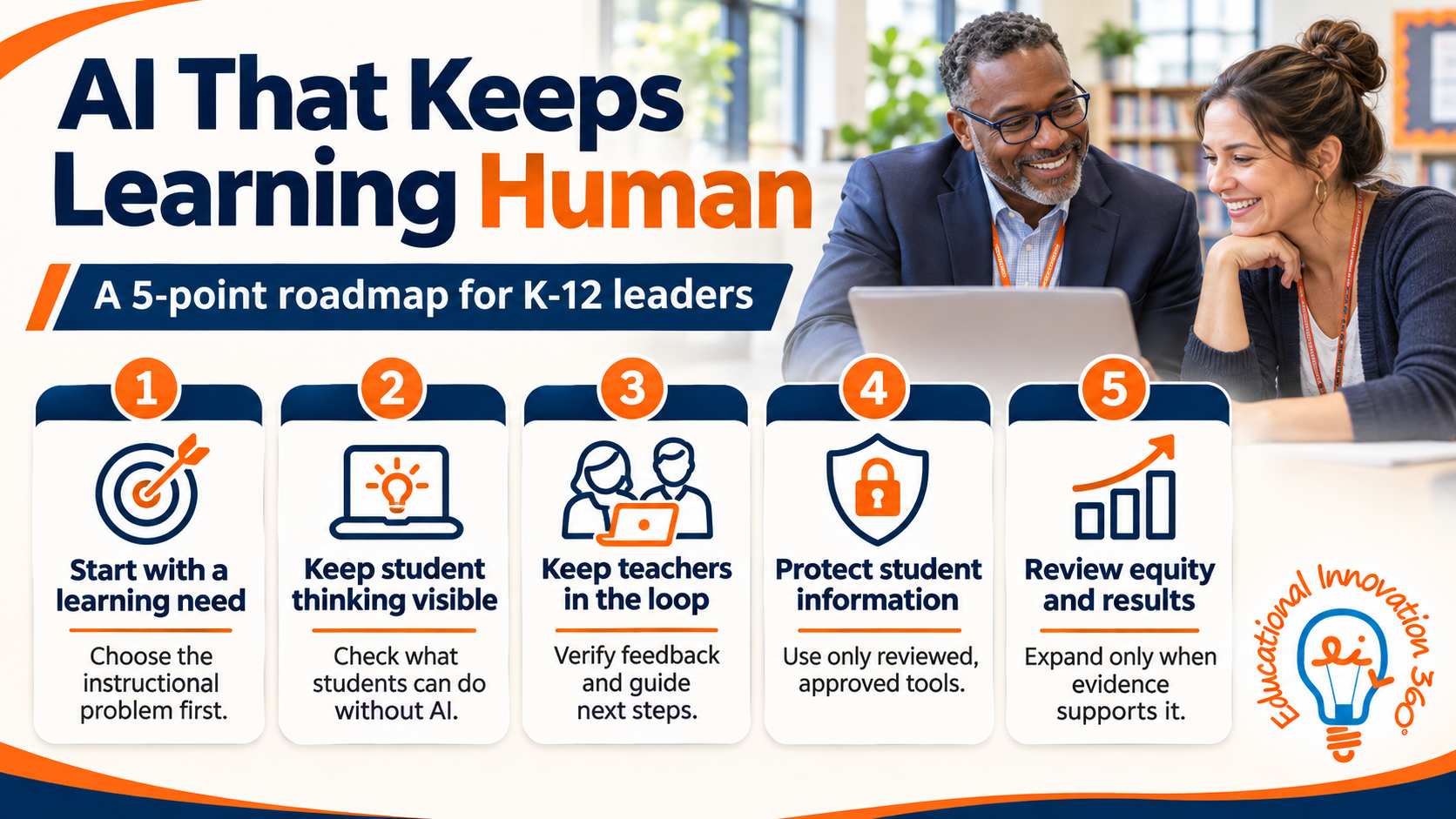
Ei360: Keeping Humans in the Loop
Generative AI creates text, explanations, questions, or learning materials. Ask: Is the content accurate and aligned with the learning goal?
Adaptive learning adjusts content, difficulty, or pacing based on student responses. Ask: Does the suggested pathway address the student’s actual need?
Intelligent tutoring offers hints, feedback, and guided steps. Ask: Does it help the student reason through the problem, or simply provide the answer?
Assessment and analytics tools organize responses and surface patterns. Ask: What will the teacher do differently with this information?
A tool’s “AI-powered” label does not show whether it improves learning. Choose a product based on the instructional job it is meant to do.
AI use is growing faster than guidance
RAND’s 2025 surveys found that 54% of students and 53% of surveyed teachers reported using AI for school. More than 80% of students said their teachers had not explicitly taught them how to use AI for schoolwork. In spring 2025, 45% of principals reported having school or district AI guidance, while 34% of teachers reported policies addressing AI and academic integrity (Doss et al., 2025).
Teachers also report using AI to support their work. In a Gallup–Walton Family Foundation survey, 60% of public K–12 teachers said they used AI for work during the 2024–2025 school year, and 32% used it at least weekly. Weekly users estimated that they saved an average of 5.9 hours per week (Ash, 2025).
Those figures come from different surveys, with different questions and participants, so they should not be compared as if they measure the same thing. The reported time savings are self-estimates, not proof that every teacher saves the same amount. Schools should measure the time required to check and correct AI output as well as the time saved.
The findings do point to a need for shared expectations. Students need to understand when AI use is allowed, how to check its work, and what parts of an assignment must reflect their own thinking. Teachers need clear guidance and time to learn how to use tools responsibly.
A better-looking assignment does not always mean better learning
In a randomized field experiment involving nearly 1,000 high school mathematics students in Turkey, students using a general-purpose GPT-4 tool performed better during supported practice. When they took an exam without AI access, however, their performance was about 17% lower than the control group’s performance. This was a relative reduction, not a 17 percentage-point drop. A tutor designed with teacher-informed safeguards largely avoided that negative effect, but did not produce a statistically significant advantage over the control group on the independent exam (Bastani et al., 2025).
The study examined a specific math intervention in one school, using technology deployed in 2023. It does not show that all AI tutoring harms learning. It does highlight a question every pilot should answer: Can students explain and apply the skill when the AI tool is no longer available?
AI may also support educators behind the scenes. Stanford’s SCALE Initiative summarized research on Tutor CoPilot, a tool designed to help human tutors choose questions and explanations. The research reported a four percentage-point increase in topic mastery overall and a nine-point increase among students working with lower-rated tutors. These findings relate to a particular tutoring approach; they do not show that a chatbot can replace an educator (SCALE Initiative, 2026).
Together, these findings suggest a useful direction: prioritize AI that helps teachers make informed decisions while preserving students’ opportunities to think and practice independently.
Five practical strategies for instructional leaders
The strategies below are proposed implementation practices informed by the research. The examples are illustrative.
1. Define the instructional problem before choosing a product
Start with a specific learning need, not a technology purchase.
Instead of, “We need adaptive learning,” a team might say:
“Students can complete fraction procedures but struggle to explain equivalent fractions using visual models.”
Then decide what evidence would show progress: a baseline task, student explanations, work samples, an assessment completed without AI, and a later check of retention.
For example, a fifth-grade team might pilot a fractions tool during selected lessons. Teachers could review its recommendations while also asking students to draw and explain equivalent fractions. If a student completes the digital pathway but cannot explain the concept, the teacher can provide additional support instead of allowing the platform to advance the student automatically.
2. Connect assessment information to a teaching response
A dashboard is useful only if it helps someone decide what to do next. Teams can build a simple routine:
Identify a shared learning target.
Collect a short set of student responses.
Compare the system’s interpretation with students’ actual work.
Group students by demonstrated need.
Reteach or extend learning.
Check understanding again without AI.
For example, a mathematics dashboard might flag incorrect equation solutions. A closer look could show that some students misunderstand inverse operations while others are making arithmetic errors. Those students may need different instruction, even though the dashboard initially placed them in the same category.
Leaders can support this work by protecting planning time for teachers to review student thinking and decide on next steps.
3. Use AI to draft feedback, with teachers responsible for grading
A reasonable starting point is using AI to help draft formative feedback, rather than assigning it high-stakes grading decisions.
A district workflow might require teachers to use an approved rubric and system, review AI-generated feedback before sharing it, and retain responsibility for grades. Students should also have a clear way to question feedback they believe is inaccurate.
For example, an English teacher could use an approved tool to draft comments about the claims and evidence in student essays. The teacher checks whether the comments match each student’s work. Students then decide which suggestion to accept, revise, or reject—and explain why.
This makes feedback part of the learning process, rather than a set of corrections students are expected to accept automatically.
4. Teach AI literacy as judgment, not just prompting
Students need more than tips for writing prompts. They need habits that help them assess AI’s contribution and limitations.
A practical sequence can ask students to:
Explain what AI contributed to their work.
Verify factual claims against credible sources.
Look for errors and possible bias.
Protect personal and confidential information.
In a history lesson, students might compare an AI-generated account of an event with primary sources selected by the teacher. They can identify unsupported claims, notice missing perspectives, and write their own evidence-based interpretation.
Assignment directions can make expectations clear:
“You may use AI to generate questions or suggest an outline. Your claims, source evaluation, and final argument must reflect your own reasoning. Disclose how you used the tool.”
Clear instructions matter. RAND found that half of students worried about being falsely accused of using AI to cheat (Doss et al., 2025).
5. Make privacy review part of instructional planning
Schools should conduct their own privacy review before using an AI product with student information. Federal guidance explains that disclosure of personally identifiable information from education records generally requires consent unless an applicable FERPA exception permits it. The school official exception includes conditions related to school control and limits on unauthorized use or redisclosure (U.S. Department of Education, 2014).
Before a tool is approved, leaders should ask:
What student information does it collect, and why?
Who can access the information?
Can the provider use it for model training, advertising, or other purposes?
How long is the information retained, and how can it be deleted?
What steps can students and families take if they have a concern?
What age restrictions or other requirements apply?
As a proposed safeguard, districts should prohibit staff from entering identifiable student records into unapproved consumer AI tools. Removing a student’s name alone should not be treated as a full privacy review.
Keep personalization connected to rigorous instruction
Adaptive learning should help students reach grade-level learning, not keep some students indefinitely in prerequisite practice.
When reviewing a pilot, consider whether students have comparable access to approved tools and devices; whether feedback works for multilingual learners and students with disabilities; whether recommendations differ across student groups; and whether all students continue to receive grade-level instruction, teacher support, and opportunities to learn with peers.
For example, if an AI system repeatedly gives a multilingual learner low writing scores, a teacher should compare the system’s comments with the rubric and the student’s explanation before changing the student’s placement or assigning remediation.
Human review is especially important when AI-supported judgments may influence consequential educational decisions. UNESCO’s AI competency framework emphasizes human agency, ethics, and educators’ role in applying AI thoughtfully (UNESCO, 2024).
A 90-day plan for a focused pilot
A limited pilot can help a district learn before expanding. The timeline below is a proposed planning framework, not a research-validated schedule.
TimelineLeadership actionsEvidence to collectDays 1–30: Define and prepareSelect one instructional problem, review current AI use, assess privacy and accessibility, set permitted uses, and gather baseline evidence.Pilot plan, approved-tool list, baseline assessment, family communicationDays 31–60: Pilot and coachTry the tool in a limited setting, coach participating teachers, check output accuracy, and collect work samples and teacher time logs.Implementation notes, examples of corrected output, student feedbackDays 61–90: Evaluate and decideCompare independent learning outcomes, review subgroup patterns and costs, and gather teacher and family perspectives.A documented decision to expand, revise, extend the evaluation, or discontinue
Include classroom teachers, instructional leaders, special education and multilingual-learning expertise, technology and privacy staff, and student or family perspectives in the pilot team.
Measure learning, not just logins
Logins, time on a platform, and completed modules can show that students used a tool. They cannot, on their own, show that students learned.
Before scaling a pilot, ask:
Learning: Can students explain and apply the skill without AI?
Retention: Can they demonstrate their understanding later?
Instruction: Did teachers make better or faster instructional decisions?
Workload: Did time savings remain after teachers checked and corrected AI output?
Equity and safety: Could students access the tool, and were problems identified and addressed?
Set expectations before the pilot begins. Decide what evidence would support expansion and what would prompt a pause. Privacy failures, repeated inaccurate feedback, or weaker independent learning deserve a careful review, even if student engagement is high.
The next step: one problem, one use case, one measure
AI implementation should move from experimentation toward instructional accountability. For district leaders, principals, and instructional coaches, a practical starting point is to choose one learning problem, one carefully reviewed use case, and one measure of student learning that does not depend on the AI tool.
Then support teachers through coaching, make expectations visible to students and families, and expand only when the evidence supports it.
The goal is stronger teaching, better-informed decisions, and students who become more capable with AI—and without it.
References
Ash, A. M. (2025, June 24). Three in 10 teachers use AI weekly, saving six weeks a year. Gallup.
Bastani, H., Bastani, O., Sungu, A., Ge, H., Kabakcı, Ö., & Mariman, R. (2025). Generative AI without guardrails can harm learning: Evidence from high school mathematics. Proceedings of the National Academy of Sciences, 122(26), Article e2422633122. https://doi.org/10.1073/pnas.2422633122
Doss, C. J., Bozick, R., Schwartz, H. L., Chu, L., Rainey, L. R., Woo, A., Reich, J., & Dukes, J. (2025). AI use in schools is quickly increasing but guidance lags behind: Findings from the RAND survey panels (Report No. RR-A4180-1). RAND Corporation. https://doi.org/10.7249/RRA4180-1
Education Commission of the States. (n.d.). Trending topics in state education policy.
Global Schools Group. (2026, October 26). 10 current trends in education shaping the future of learning.
SCALE Initiative. (2026, September 1). How Tutor CoPilot systems scale teaching capacity worldwide. Stanford University.
UNESCO. (2024). AI competency framework for teachers.
U.S. Department of Education. (2014, February). Protecting student privacy while using online educational services: Requirements and best practices.
Vanderbilt Peabody College Admissions. (2026, April 8). 6 trends in education shaping the future of learning.