
Say Less, Ask Better: Building a Coaching Habit That Improves Instruction
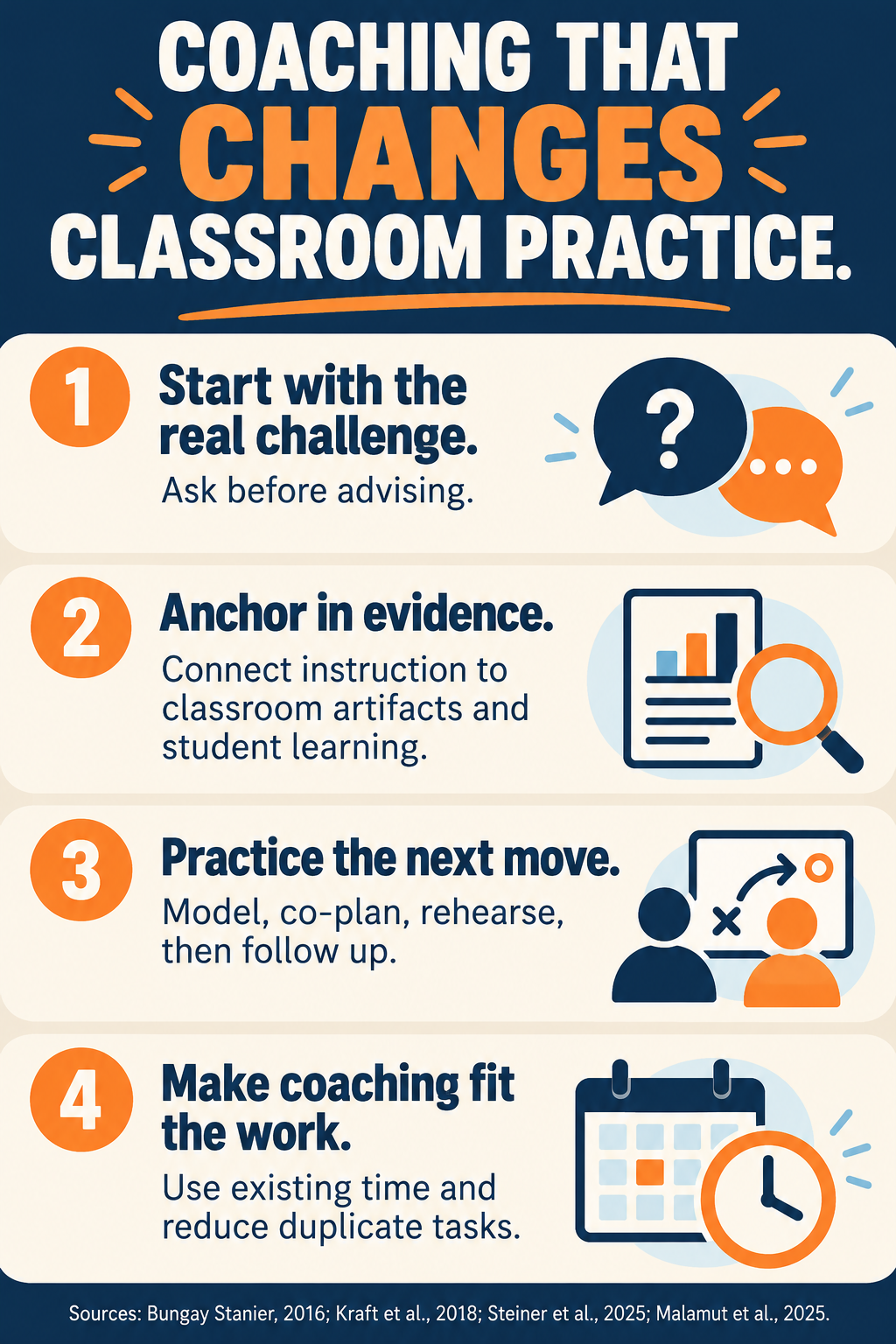
Coaching that changes
Principals help create the conditions teachers need to improve instruction. Effective coaching combines thoughtful questions with classroom evidence, opportunities to practice, and follow-up. The Coaching Habit offers a practical framework for coaching conversations (Bungay Stanier, 2016), while research on teacher coaching examines its effects on instruction and student achievement.
What the research says
Kraft et al. (2018) analyzed 60 studies and found average effects of 0.49 standard deviations on instructional practice and 0.18 standard deviations on student achievement. These findings support sustained coaching, not the idea that every conversation labeled “coaching” will have the same impact.
Effective coaching is individualized, sustained, focused on specific skills, and connected to classroom practice. The research also has limits: much of it involved literacy coaching in early childhood and elementary settings, and larger-scale studies found smaller effects than smaller trials (Kraft et al., 2018).
Time matters, too. In RAND’s 2025 survey, teachers reported working an average of 49 hours per week, about 10 beyond their contracted time. While fewer teachers reported intending to leave than in 2024, their well-being remained lower than that of comparable working adults (Steiner et al., 2025). These findings do not show that coaching prevents burnout, but they reinforce the need to make coaching part of existing work time and reduce unnecessary tasks.
Automated tools may help organize classroom evidence, but they require human judgment. A 2025 exploratory study found that coaches used automated feedback to examine instructional patterns, while raising concerns about accuracy, particularly when capturing student talk (Malamut et al., 2025).
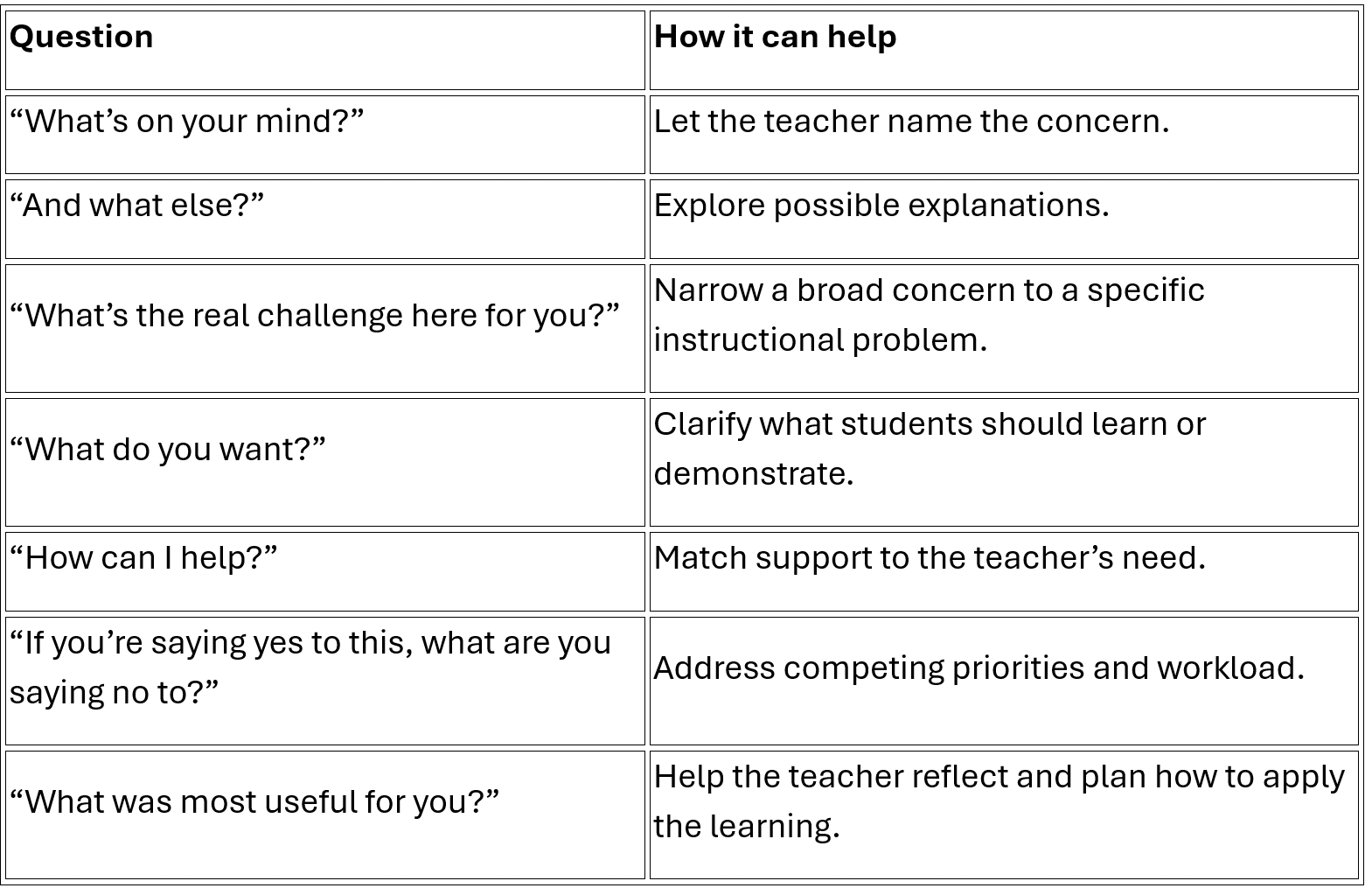
Use coaching questions to focus the conversation
Bungay Stanier’s questions can help principals and coaches clarify concerns, identify support, and set next steps (Bungay Stanier, 2016).
You do not need to ask every question in every meeting. Choose the one that moves the conversation forward, then listen and decide whether the teacher needs more reflection, evidence, or direct support.
Five ways principals can strengthen coaching
1. Clarify the challenge before recommending a solution. If a teacher says, “My students cannot work independently,” ask what students do when they get stuck and what evidence points to the barrier. The issue may be unclear directions, task difficulty, or students’ need for a model. Define the problem before choosing a strategy.
2. Use one manageable piece of classroom evidence. Bring a few student responses, brief observation notes, an exit-ticket summary, or another relevant artifact. Ask, “What do you notice?” and “What might explain that?” For example, “Four of six students chose the right operation but did not explain why” gives the conversation a specific focus (Malamut et al., 2025).
3. Combine questions with instructional expertise. Coaching is not only questioning. Kraft et al. (2018) found that most studies included additional professional learning elements. Coaches can model a strategy, co-plan a lesson, rehearse a teacher move, and provide feedback before reviewing student work.
4. Make time part of the plan. Use existing planning periods, review work teachers already collect, and connect coaching to a school priority. When possible, replace duplicate forms or meetings rather than adding new ones (Steiner et al., 2025).
5. Review automated feedback with the teacher. Use district-approved tools and follow privacy procedures. Verify findings against classroom evidence, ask what the tool missed, and avoid treating automated measures as evaluation judgments. A dashboard can prompt inquiry; it should not make the instructional decision (Malamut et al., 2025).
A simple coaching cycle
A fourth-grade teacher notices that students answer reading questions but rarely support their responses with details from the text.
Goal: Students support an inference with relevant evidence and explain the connection.
Teacher action: Model a response, then guide students through one.
Coach support: Co-plan and rehearse the model.
Evidence: Review student responses after the lesson.
Reflection: “What improved, and what still needs instruction?”
This kind of focused cycle connects teacher practice to student learning (Kraft et al., 2018).
A manageable next step
For the next month, choose one coaching behavior to practice. Protect time for a few focused coaching cycles, connect each cycle to classroom evidence, and ensure teachers can rehearse instructional strategies. Keep brief notes on the challenge, goal, evidence, support, and follow-up. Coaching works best when teachers have both a useful conversation and a real opportunity to apply what they learn.
Resources
Bungay Stanier, M. (2016). The coaching habit: Say less, ask more & change the way you lead forever. Book PDF
Kraft, M. A., Blazar, D., & Hogan, D. (2018). The effect of teacher coaching on instruction and achievement: A meta-analysis of the causal evidence. Review of Educational Research, 88(4), 547–588. Research article
Malamut, J., Demszky, D., Bywater, C., Reinhart, M., & Hill, H. C. (2025). Facilitating evidence-based instructional coaching with automated feedback on teacher discourse (EdWorkingPaper No. 25-1298). Working paper
Steiner, E. D., Levine, P. R., Doan, S., & Woo, A. (2025). Teacher well-being, pay, and intentions to leave in 2025: Findings from the State of the American Teacher Survey. RAND report