
Coaching That Sticks: Turning Preschool Learning Into Daily Practice
Preschool educators make hundreds of instructional decisions throughout the day: how to respond to a child’s question, support a peer interaction, guide a transition, or adapt an activity so every child can participate. A workshop can introduce useful strategies, but teachers often need ongoing support to apply those strategies in real classroom moments.
Job-embedded coaching helps bridge that gap. It connects professional learning to teachers’ daily work through a cycle of shared goals, observation, reflection, and practice. Research suggests that coaching can strengthen teachers’ knowledge and instructional skills and support children’s development, though results depend on the practices being coached and the conditions programs create for coaching (Yang et al., 2022). Wiley Online Library
Why job-embedded coaching matters
Workshops, courses, and online modules can build knowledge and introduce evidence-based practices. But knowing about a strategy does not always make it easy to use. A teacher may understand the value of open-ended questions and still find it difficult to use them during a busy small-group activity.
Practice-based coaching helps teachers apply a specific practice in the setting where they work. In this approach, the coach and teacher identify a goal, plan how to work toward it, observe the practice, and reflect on what happened. The process can complement other professional development and may take place in person or with technology-supported coaching (Office of Head Start, n.d.). HeadStart.gov
For example, instead of setting a broad goal to “improve language instruction,” a teacher and coach might focus on one practice: during morning centers, the teacher will use open-ended prompts and build on children’s responses. The coach can observe that interaction, record evidence, and help the teacher decide what to try next.
What effective coaching looks like
Practice-based coaching includes a collaborative partnership and three connected elements: shared goals and action planning, focused observation, and reflection with feedback (Office of Head Start, n.d.).
Build a collaborative partnership
Coaching works best when teachers can discuss challenges, try new practices, and reflect honestly. Coaches can support that trust by recognizing teachers’ strengths, listening carefully, and treating the teacher as a partner in setting goals. Head Start’s coaching competencies also emphasize respectful partnerships, professional boundaries, and clear agreements about roles and expectations (Office of Head Start, n.d.). HeadStart.gov
A program may set priorities such as oral language, inclusive instruction, or positive behavior support. Within those priorities, teachers should have a meaningful role in choosing a specific practice that connects to their classroom and children’s needs.
Set specific, observable goals
Goals like “be more intentional” or “improve classroom management” are difficult to observe and act on. A more useful goal names what the teacher will do and when.
For example: “During large-group instruction, the teacher will give a visual cue, state the participation expectation, and offer at least two ways for children to respond, such as partner talk, movement, or response cards.”
A focused goal gives the teacher and coach something concrete to practice and review. It can also help them consider whether children with disabilities, dual language learners, and quieter children have meaningful ways to participate.
Observe for evidence
Focused observation is tied to the agreed-upon goal. A coach might tally open-ended questions, record how often children respond during a small-group activity, or note when a learning opportunity is embedded in a classroom routine. The purpose is to gather useful information, not to evaluate the teacher.
Evidence can help the teacher reflect:
What did I try?
How did children respond?
Which moments went well?
What would I adjust next time?
Video can offer another way to review practice after the demands of teaching have passed. Head Start’s Coaching Companion, for example, supports sharing classroom videos and tracking progress through the core practice-based coaching components (Office of Head Start, n.d.). HeadStart.gov
Reflect, give feedback, and practice
Effective feedback is specific, timely, and connected to the coaching goal. A coach might say: “During the 10-minute read-aloud, you asked six recall questions and one open-ended question. When you asked why the character felt worried, four children shared ideas. What did you notice about that moment?”
That kind of reflection can help a teacher decide what to try next. The teacher and coach might rehearse a new question, plan a prompt for a particular child, or model a response to a challenging situation. Time to practice is part of the learning cycle.
What Does Research Tell Us About Early Childhood Coaching Teachers?
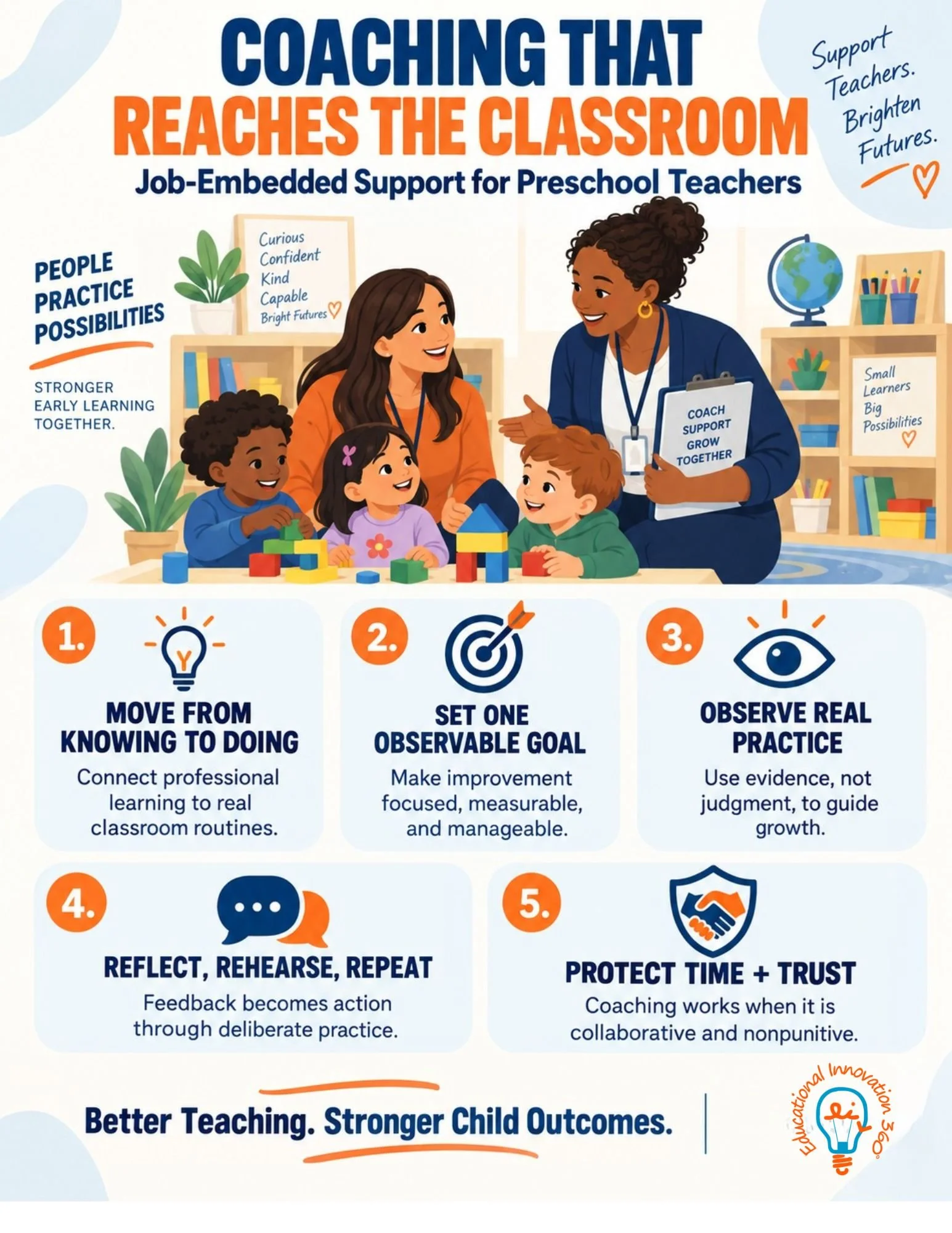
Ei360: When Coaching Reaches the Classroom
A systematic review of 33 experimental and quasi-experimental studies found positive effects of early childhood coaching on teachers’ knowledge and instructional competencies. The review also found positive effects across several child-development areas, including language and literacy, social-emotional development, and academic skills (Yang et al., 2022). These findings support coaching as a promising form of professional learning, while also underscoring the importance of how coaching is designed and delivered. Wiley Online Library
One example is Tools for Teachers, a professional-development intervention that helped preschool teachers use embedded instruction with children with disabilities. In an efficacy trial, teachers who received the intervention with on-site coaching implemented embedded-instruction practices more frequently and accurately than teachers in the self-coaching or business-as-usual groups. Children in the on-site coaching group also had stronger pre-academic outcomes in language, early literacy, and basic concepts. The study did not find differences among groups in social-emotional or adaptive behavior outcomes, so the findings should be understood as specific to the program and measured outcomes (Institute of Education Sciences, n.d.). IES
A 2026 study of peer coaching to support assistive technology use in inclusive preschool classrooms found that participating teachers and coaches perceived benefits for teachers’ understanding and use of assistive technology, as well as children’s engagement and participation. Participants also identified time constraints, classroom-management demands, and staffing shortages as barriers (Schladant et al., 2026). Because this study examined participants’ perceptions, it offers useful implementation insights rather than proof of effects across all preschool settings. Springer Nature Link
Taken together, the research points to several practical lessons:
Focus coaching on a defined teaching practice.
Give teachers opportunities to apply the practice with active support.
Consider how coaching time, staffing, and children’s attendance affect implementation.
Track changes in teacher practice as well as relevant child outcomes.
Interpret results in light of the specific practices and outcomes studied.
What are Common Implementation Challenges for Preschools?
Calling professional development “job-embedded” does not guarantee that it will be effective. Programs need to create the conditions for coaching to happen.
Limited time and staffing. Teachers may lack protected time for coaching conversations, and coaches may be stretched across too many classrooms. Recent research on preschool peer coaching identified time constraints, classroom demands, and staffing shortages as barriers (Schladant et al., 2026). Leaders should schedule coaching during paid work hours, provide classroom coverage, and set realistic coaching caseloads.
Confusion between coaching and evaluation. Teachers may be less willing to discuss challenges if they are unsure whether coaching notes or observations will be used in formal evaluations. Programs should explain how coaching information will be used and distinguish developmental support from personnel appraisal.
Goals that are too broad. Trying to address every aspect of classroom practice at once can make progress hard to see. A narrow, observable goal gives the teacher and coach a manageable starting point.
Insufficient coach preparation. Strong teaching experience does not automatically prepare someone to coach. Coaches need support in adult learning, observation, feedback, early childhood pedagogy, cultural responsiveness, and professional boundaries. Head Start’s coaching competencies provide a framework for the knowledge and skills involved (Office of Head Start, n.d.). HeadStart.gov
What are Educational Innovation 360’s Recommendations for preschool leaders
Preschool directors, principals, Head Start education managers, and district leaders can strengthen coaching by making it part of a coherent professional-learning system.
Choose a clear instructional focus. Use child data, classroom needs, and program priorities to select a practice, such as language-rich interactions, early math talk, embedded instruction, or positive behavior support.
Use a consistent coaching process. A shared model helps teachers and coaches understand how goals, observations, and feedback fit together.
Protect time for coaching. Schedule conferences during paid work hours and arrange coverage so teachers can participate without supervising children at the same time.
Clarify the purpose and boundaries. Explain what coaching records are for and how coaching relates to formal evaluation.
Define observable practices. Agree on what the teacher will try and what evidence will help the pair review progress.
Connect coaching to other professional learning. Workshops and courses can introduce ideas; coaching can help teachers apply them in the classroom (Office of Head Start, n.d.).
Review implementation and outcomes. Track whether coaching cycles take place, whether the targeted practice changes, and whether children show relevant progress.
Respect teacher expertise and context. Coaching should recognize the knowledge and experience educators bring, as well as the language, culture, and needs of the children and families they serve.
How do we turn learning into classroom practice?
Job-embedded coaching gives preschool teachers a structured way to try a focused practice, examine what happens, and plan a next step. Research supports its potential to strengthen teaching and, in some cases, children’s learning. Its success also depends on practical conditions: prepared coaches, collaborative relationships, clear goals, and protected time.
When programs provide those conditions, professional learning can become part of the work of teaching, connected to real classroom interactions and responsive to the children who are there.
References
Institute of Education Sciences. (n.d.). Impact of professional development on preschool teachers’ use of embedded-instruction practices: An efficacy trial of Tools for Teachers. U.S. Department of Education. https://ies.ed.gov/use-work/awards/impact-professional-development-preschool-teachers-use-embedded-instruction-practices-efficacy-trial
Office of Head Start. (n.d.). Head Start Coaching Companion. https://headstart.gov/professional-development/head-start-coaching-companion/head-start-coaching-companion
Office of Head Start. (n.d.). Practice-based coaching (PBC). https://headstart.gov/professional-development/article/practice-based-coaching-pbc
Office of Head Start. (n.d.). The practice-based coach competencies. https://headstart.gov/publication/practice-based-coach-competencies
Schladant, M., Garilli, A., Balzano, G., Natale, R., & Elbaum, B. (2026). Job-embedded peer coaching professional development to support preschool assistive technology use: Teachers’ and peer coaches’ perceptions. Early Childhood Education Journal, 54, 2631–2641. https://doi.org/10.1007/s10643-025-02048-w
Yang, W., Huang, R., Su, Y., Zhu, J., Hsieh, W.-Y., & Li, H. (2022). Coaching early childhood teachers: A systematic review of its effects on teacher instruction and child development. Review of Education, 10(1), e3343. https://doi.org/10.1002/rev3.3343
References
Head Start. (2022, April 6). Practice-based coaching (PBC) coach competencies. U.S. Department of Health and Human Services.[headstart]
Head Start. (2025, July 8). Practice-based coaching (PBC). U.S. Department of Health and Human Services.[headstart]
Head Start. (2026, February 18). Head Start coaching companion. U.S. Department of Health and Human Services.[headstart]
Office of Head Start. (n.d.). Practice-based coaching (PBC). HeadStart.gov. https://headstart.gov/professional-development/article/practice-based-coaching-pbc
Institute of Education Sciences. (n.d.). Impact of professional development on preschool teachers’ use of embedded instruction practices. U.S. Department of Education.[ies.ed]
Schladant, M., Garilli, A., Balzano, G., et al. (2026). Job-embedded peer coaching professional development to support preschool assistive technology use: Teachers’ and peer coaches’ perceptions. Early Childhood Education Journal, 54, 2631–2641. https://doi.org/10.1007/s10643-025-02048-w[link.springer]
Yang, W., Huang, R., Su, Y., Zhu, J., Hsieh, W.-Y., & Li, H. (2022). Coaching early childhood teachers: A systematic review of its effects on teacher instruction and child development. Review of Education, 10(1), Article e3343. https://doi.org/10.1002/rev3.3343