
Silence the Chaos: Reclaiming Your Sanity from the Interrupting Epidemic.
We know that managing impulsive classroom behaviors—like students blurting out answers—is about more than discipline. It’s about equipping teachers with the tools to build self-regulation, foster respectful participation, and create a positive learning culture where every student feels heard. Recent evidence highlights that by setting explicit expectations, integrating social-emotional learning (SEL), and leveraging engaging routines, teachers can curb disruptions while building skills students will use for life.
What the Research Tells Us
Since the pandemic, student behavior challenges have risen. A 2025 EdWeek Research Center survey found that nearly half of educators reported increased classroom disruptions such as blurting (EdWeek Research Center, 2025). The good news? Research shows that when students believe they’ll be recognized or called on, they’re more likely to regulate their impulses and wait (Counselor Chelsey, n.d.). Schools are increasingly adopting visual supports—emotion charts, timers, and self-monitoring checklists—that give students concrete tools for managing behavior and building confidence.
At the same time, SEL lessons targeting impulse control, goal-setting, and empathy are trending, helping students practice patience, reflection, and collaborative problem-solving (Education Week, 2025).
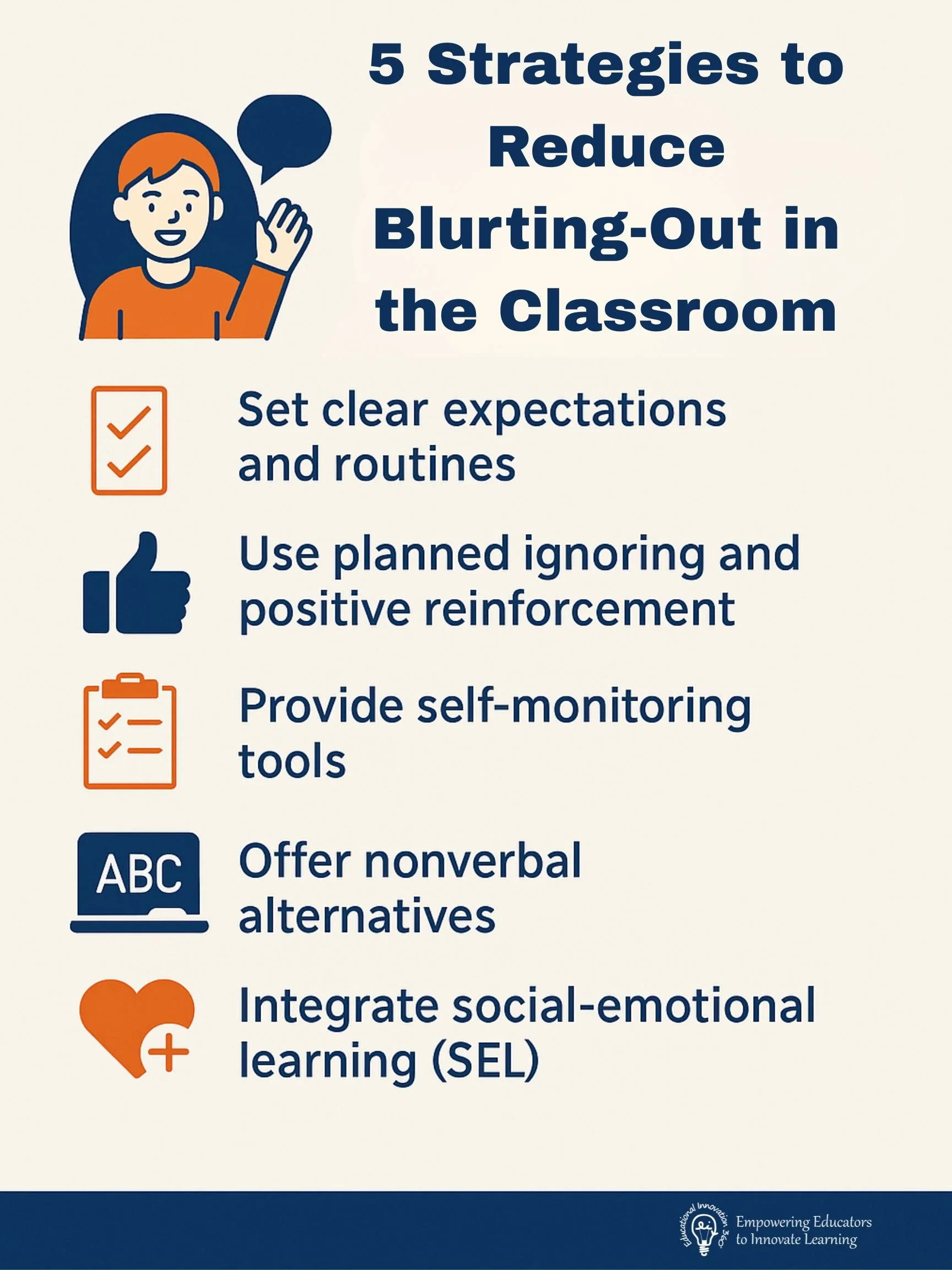
5 Strategies to Reduce Blurt outs
Best Practices for Teachers
1. Planned Ignoring & Positive Reinforcement
Celebrate students who raise their hands and wait, using praise and meaningful rewards. Positive reinforcement—such as extra recess or choice time—helps students see that patient participation pays off.
2. Self-Monitoring Tools
Have students track their own blurts with tallies or charts. This builds self-awareness and encourages responsibility, especially when tied to individual or group incentives.
3. Explicit Expectations & Routines
Set the tone early and often. Post clear rules, model expected behaviors, and revisit them regularly. Visible cues help remind students when to share and when to listen.
4. Structured Alternatives
Offer nonverbal participation options such as whiteboards, sticky notes, or the “bubble mouth” strategy. Simple structures like “ask three then me” encourage peer support before teacher intervention.
5. Environmental & Emotional Supports
Arrange seating strategically, reduce distractions, and create spaces for self-regulation. Short breathing exercises or mindfulness breaks can reset focus and minimize impulsivity.
6. SEL Integration
Make impulse control part of daily learning. Role-play scenarios, group discussions, and collaborative projects allow students to practice patience, empathy, and active listening in authentic ways.
Moving from Disruption to Growth
When teachers blend research-based practices with SEL and consistent reinforcement, classrooms shift from reactive management to proactive growth. Students don’t just stop blurting—they gain the lifelong skills of self-regulation, respect, and collaboration. That’s the type of learning culture we believe in at Educational Innovation 360°.
References
ADDitude. (2025, July 8). How to stop students from blurting: Activities for impulsive ADHD kids. https://www.additudemag.com/how-to-stop-students-from-blurting-activities-adhd/
Counselor Chelsey. (n.d.). Self-control strategies for kids who blurt out. https://www.counselorchelsey.com/blog/blurtingtips
Education Week. (2025, January 20). Elementary students can’t manage their emotions. What schools can do to help. https://www.edweek.org/leadership/elementary-students-cant-manage-their-emotions-what-schools-can-do-to-help/2025/01
EdWeek Research Center. (2025, January 8). Is student behavior getting any better? What a new survey says. https://www.edweek.org/leadership/is-student-behavior-getting-any-better-what-a-new-survey-says/2025/01
Lucky Little Learners. (n.d.). Ideas to help with blurting out in the classroom. https://luckylittlelearners.com/ideas-to-help-with-blurting-out-in-the-classroom/
Responsive Classroom. (2024, June 24). In case of the blurts. https://www.responsiveclassroom.org/in-case-of-the-blurts/
Scholastic. (n.d.). Seven ways to cure the blurts. http://teacher.scholastic.com/professional/classmgmt/cureblurts.htm
What I Have Learned Teaching. (2025, June 1). 6 ways to stop students from blurting out in the classroom. https://whatihavelearnedteaching.com/6-ways-stop-students-blurting-classroom/