
The Knowledge Monopoly: How AI is Unbundling the University
For centuries, the traditional university held a physical and intellectual monopoly. If you wanted access to high-level knowledge, specialized networks, or a credible career "signal," you had to step onto a campus. However, as noted in the recent talk, “Farewell to Traditional Universities: What AI Has in Store for Education,” we are entering an era where intelligence is becoming "infrastructure" rather than a destination (Future AI, 2026). This shift marks the end of the university’s status as a gated community for knowledge and the beginning of its transformation into something far more fluid.
From Scarcity to Abundance
Historically, universities were built around scarcity: limited library books, a finite number of lecture seats, and a handful of experts. Generative AI has shattered this model. Large language models (LLMs) and AI tutors now allow for the "manufacturing" of intelligence, turning explanation and instruction into a 24/7 utility available to anyone with a screen (Future AI, 2026).
Research confirms that this isn't just a futurist's dream; it is happening now. A 2025 randomized controlled trial (RCT) found that custom AI tutors allowed college students to learn significantly more in less time than those in traditional active-learning classrooms (AI tutoring outperforms in-class active learning, 2025). Furthermore, a systematic review of intelligent tutoring systems concluded that these AI-driven platforms often accelerate mastery by providing the immediate, adaptive feedback that a single human professor in a 300-person lecture hall simply cannot provide (A systematic review of AI‑driven intelligent tutoring systems, 2025).
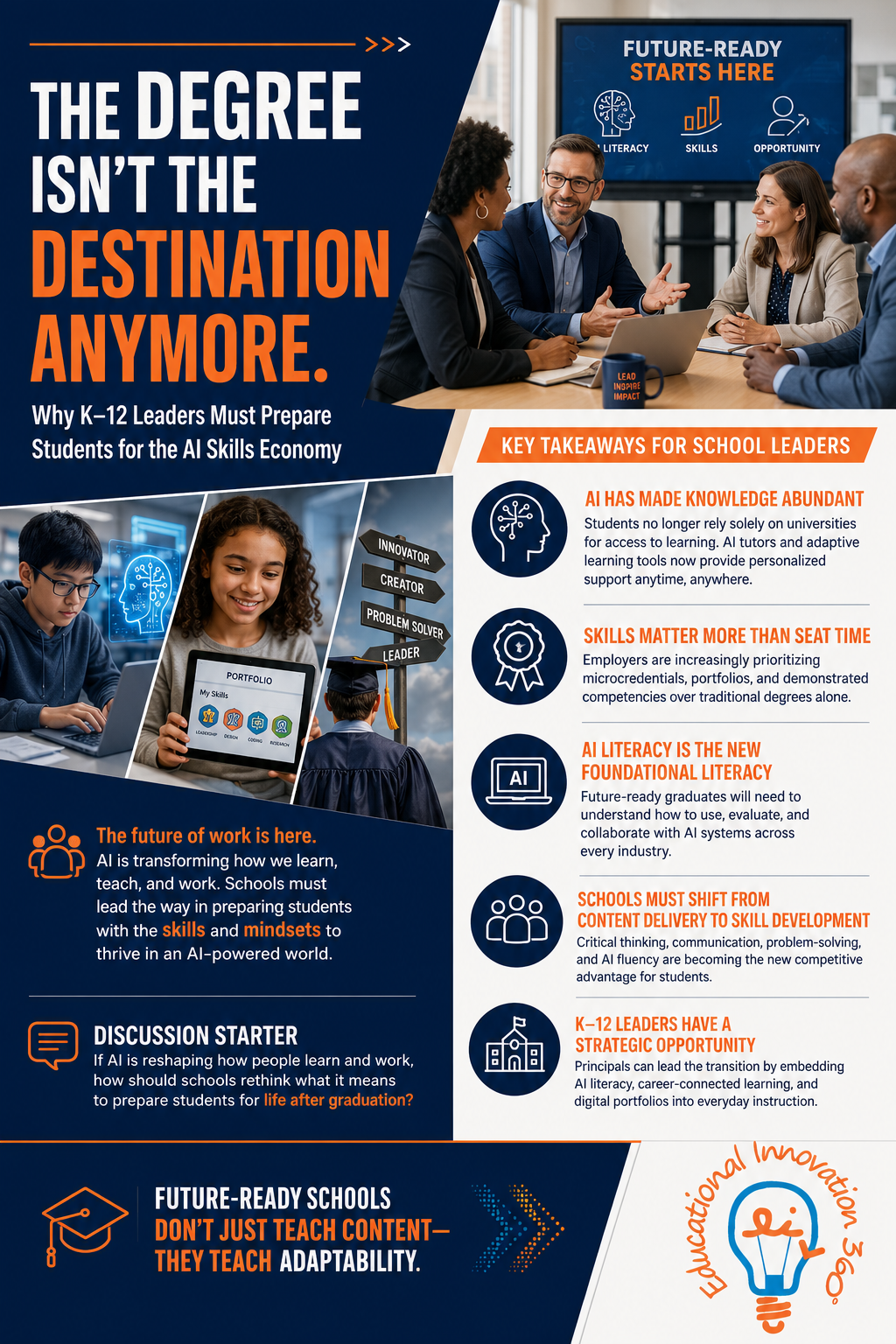
Ei360: The Degree isn’t the destination
The Great Unbundling
The "product" of a university has traditionally been a bundle of three things: Knowledge, Networks, and Credentials. AI is systematically unbundling all three (Future AI, 2026):
Knowledge: High-quality, adaptive explanations are now available via open platforms. Generative AI can dynamically adjust its teaching style to match a student's individual learning trajectory (Generative AI in higher education, 2025).
Networks: While campuses still offer local high-trust environments, professional networks are migrating to digital "third spaces" like Discord, open-source repositories, and global hackathons.
Credentials: The four-year degree is no longer the only way to signal competence. As skills become directly verifiable through portfolios and AI-powered simulations, the degree's role as a gatekeeper is weakening.
The Rise of the Skills Signal
Recent labor-market data show that employers are moving toward this "unbundled" future. A 2023 survey revealed that 95% of U.S. employers see the benefit of microcredentials, viewing them as evidence of up-to-date, specialized skills (UPCEA & Collegis Education, 2023). By 2025, reports showed that 85% of employers were more likely to hire applicants with recognized microcredentials, often offering higher starting salaries to those who could prove their skills through these modular "proof-of-skill" portfolios (Coursera, 2025; Future AI, 2026).
As we look toward the future, the question isn't whether the university will exist but what purpose it will serve when knowledge is everywhere.
References
AI tutoring outperforms in-class active learning: An RCT introducing an AI tutor. (2025). Nature portfolio journal (Scientific Reports).
Coursera. (2025). Coursera report shows strong support for microcredentials. Inside Higher Ed.
Future AI. (2026, January 16). Farewell to traditional universities: What AI has in store for education [Video]. YouTube. https://www.youtube.com/watch?v=sjGFJNY2v1k
Generative AI in higher education: Balancing innovation and academic integrity. (2025). British Journal of Biomedical Science.
Systematic review of AI-driven intelligent tutoring systems. (2025). Journal of Educational Technology.
UPCEA, & Collegis Education. (2023). The effect of employer understanding and engagement on non-degree credentials.
References
AI tutoring outperforms in-class active learning: An RCT introducing an AI tutor. (2025). Nature portfolio journal (Scientific Reports).
Coursera. (2025). Coursera report shows strong support for microcredentials. Inside Higher Ed.
Future AI. (2026, January 16). Farewell to traditional universities: What AI has in store for education [Video]. YouTube. https://www.youtube.com/watch?v=sjGFJNY2v1k
Generative AI in higher education: Balancing innovation and academic integrity. (2025). British Journal of Biomedical Science.
Systematic review of AI-driven intelligent tutoring systems. (2025). Journal of Educational Technology.
UPCEA, & Collegis Education. (2023). The effect of employer understanding and engagement on non-degree credentials.