
Too Many Initiatives, Not Enough Impact: The Real Problem in Schools
The biggest challenge in K–12 education today is not a lack of proven strategies; it is the chronic gap between what the research says and what actually happens in classrooms and schools. Implementation gap refers to the distance between evidence-based practices as designed and how they are actually used in schools day to day (Fixsen et al., 2005). When high-quality curricula, interventions, or reforms are adopted but not implemented with sufficient fidelity, intensity, or duration, their impact is dramatically reduced, even though the underlying research is strong (Durlak & DuPre, 2008).
For example, studies of School-Wide Positive Behavioral Interventions and Supports (SWPBIS) show that schools with higher implementation fidelity see significantly better math and reading outcomes and lower truancy and suspensions compared with schools that adopt but do not fully implement the model (Bradshaw et al., 2010). The issue in such cases is not whether SWPBIS is effective, but whether schools can implement it consistently, at scale, and over time.
Evidence that implementation, not ideas, is the bottleneck
Research across multiple initiatives suggests that most school reforms fail in the implementation phase rather than at the level of theory or design (Supovitz & Weinbaum, 2008). Syntheses of education reforms show that promising initiatives often start with strong evidence and clear theory of action but fade as they encounter fragmented systems, competing priorities, and limited supports for classroom-level change (Hargreaves & Fullan, 2012; as summarized in “Solving the Puzzle of Failed Education Reforms,” 2025).
Several patterns stand out in the literature:
Schools commonly juggle “a dozen or more” different programs simultaneously, which dilutes focus and undermines implementation quality (Durlak & DuPre, 2008).
Evaluations of state and district reforms repeatedly identify weak or inconsistent implementation as the primary reason initiatives fail to improve student achievement (Supovitz & Weinbaum, 2008; “Solving the Puzzle of Failed Education Reforms,” 2025).
Even in promising areas like school-based mental health, reviews find an “implementation and funding gap,” where many interventions have evidence of efficacy but far fewer are implemented with the supports necessary for effectiveness in real-world schools (Fazel et al., 2023).
In other words, schools are not suffering from a research shortage; they are suffering from a translation and execution shortage.
Why implementation fails in schools
The implementation gap has identifiable root causes that show up across contexts and content areas.
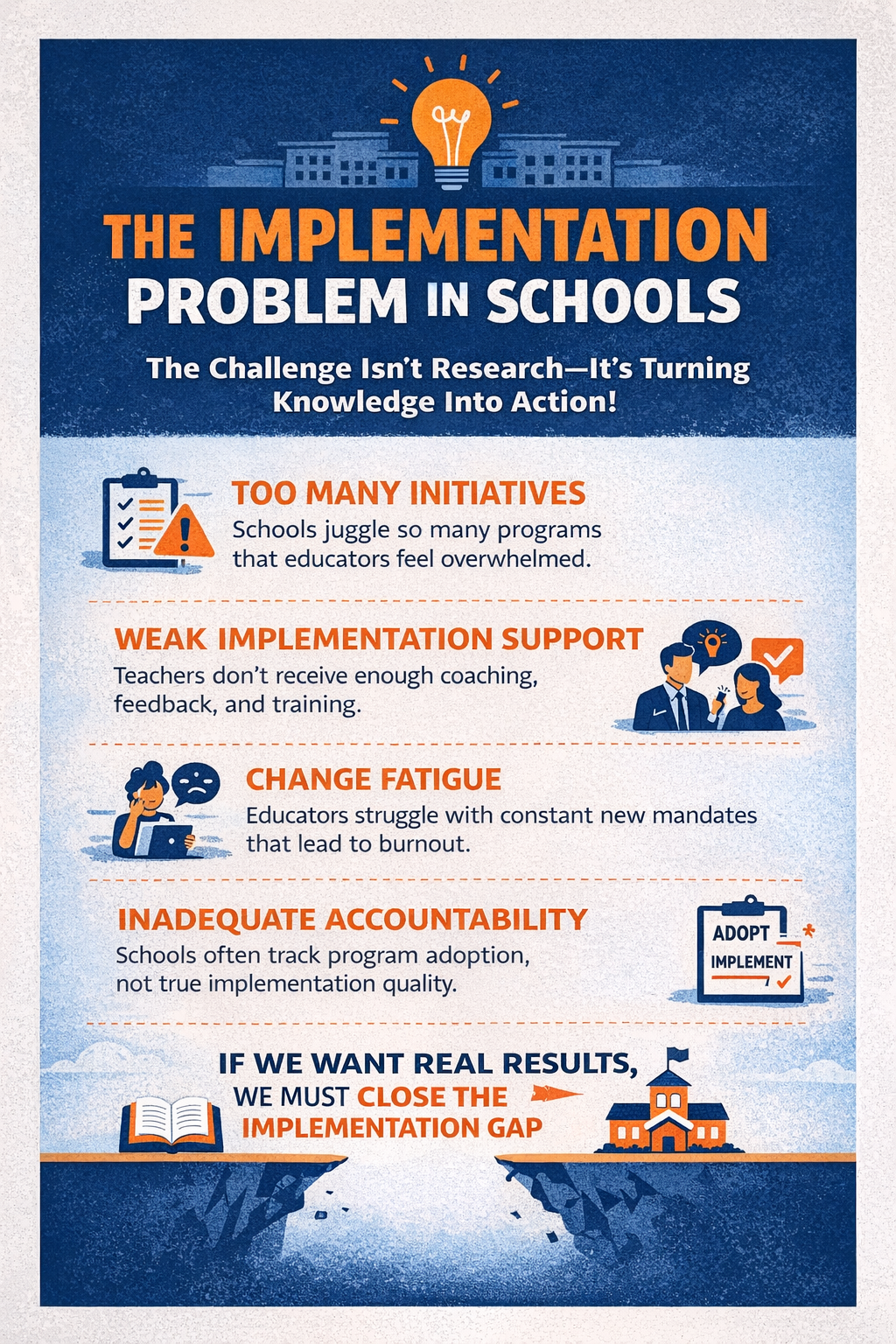
System fragmentation and initiative overload
Districts and schools often pursue multiple reforms at once, each with its own training, materials, and timelines, which creates incoherence for teachers and leaders (Supovitz & Weinbaum, 2008). One analysis describes “system fragmentation and conflicting educator belief systems” as central barriers that keep effective reforms from reaching every classroom (“Solving the Puzzle of Failed Education Reforms,” 2025).Insufficient implementation supports
Implementation science emphasizes that training alone rarely changes practice; coaching, feedback, and ongoing support are critical (Fixsen et al., 2005). In the SWPBIS study, schools with more years since initial training and a higher percentage of certified teachers had significantly better implementation quality, suggesting that time, expertise, and support structures matter (Bradshaw et al., 2010).Resource constraints and competing demands
Many schools lack the financial, human, and infrastructural resources needed to implement new pedagogies with fidelity (Challenges Faced by Schools in Implementing New Pedagogies, 2024). Limited funds for teacher training, curriculum development, or technology integration force leaders to make tradeoffs that weaken implementation.Change fatigue and resistance
Teachers and administrators report feeling overwhelmed by constant change, which can produce understandable skepticism and resistance. When reforms are perceived as short-lived or disconnected from classroom realities, educators may comply minimally rather than deeply adopting new practices (“Solving the Puzzle of Failed Education Reforms,” 2025).Weak accountability for implementation quality
Policy systems often track whether a program is “adopted” but rarely measure how well it is implemented, leading to the illusion of reform without the substance. “Weak accountability at almost all levels” allows reforms to be declared successful or completed without evidence that core practices ever reached full implementation (“Solving the Puzzle of Failed Education Reforms,” 2025).
Why implementation quality matters for student outcomes
The implementation gap is not merely a management issue; it is a student opportunity issue. Emerging research shows clear links between implementation quality and student outcomes:
In the SWPBIS scale-up study, higher implementation fidelity was significantly associated with higher math achievement, higher reading achievement, and lower truancy after controlling for baseline performance and school characteristics (Bradshaw et al., 2010).
Reviews of school-based interventions indicate that effect sizes for student outcomes are typically two to three times larger in high-fidelity implementations compared with low-fidelity ones (Durlak & DuPre, 2008).
Districts that have successfully narrowed achievement gaps often attribute their gains not to novel ideas but to disciplined implementation of a coherent set of strategies, such as strong Tier 1 instruction, targeted interventions, and systematic data use sustained over multiple years (Third Space Learning, 2026).
Conversely, opportunity gaps persist when effective practices are available but unevenly implemented across schools and classrooms, meaning that students’ access to high-quality instruction depends more on where they enroll than on what the system knows works (National Academies of Sciences, 2023).
Closing the implementation gap: Practical solutions for schools
While the implementation gap is complex, research points to concrete strategies that districts and schools can adopt to move from “knowing” to “doing.”
1. Prioritize fewer, deeper initiatives
Narrowing the focus is a powerful first step.
Conduct an “initiative inventory” at the district and school level to identify all active programs, reforms, and pilots.
Use clear criteria, alignment with vision, evidence base, equity impact, and required capacity to sunset or pause low-leverage initiatives, freeing time and attention for a small number of high-impact priorities (Supovitz & Weinbaum, 2008).
A practical example is a district choosing to concentrate on strengthening core Tier 1 instruction rather than adding multiple new interventions, based on evidence that rigorous, engaging Tier 1 is foundational for closing achievement gaps (Instructional Empowerment, 2025).
2. Build robust implementation infrastructure
Implementation success is much more likely when schools intentionally build structures to support practice change (Fixsen et al., 2005).
Key elements include the following:
Ei360: The Implementation Problem
Implementation teams: Cross-functional groups at the district and school levels that clarify roles, monitor progress, and troubleshoot barriers.
Clear practice profiles: Concrete descriptions of what the “new practice” looks like in classrooms, including observable teacher and student behaviors.
Coaching and feedback: Scheduled cycles of classroom observation, feedback, and modeling aligned to the practice profiles.
The SWPBIS research suggests that schools with more time since training and higher teacher certification rates achieved stronger implementation, underscoring the value of professional expertise and sustained support (Bradshaw et al., 2010).
3. Use data for continuous improvement, not just compliance
Data systems can either reinforce superficial implementation or drive genuine improvement.
Establish a limited set of implementation indicators (for example, frequency of core instructional strategies, attendance in intervention blocks, or fidelity checklists) alongside outcome measures like achievement and behavior.
Schedule regular data meetings where teacher teams analyze both implementation and student outcomes, then adjust instruction and supports accordingly, consistent with Institute of Education Sciences practice guide recommendations (U.S. Department of Education, as summarized in Third Space Learning, 2026).
When data are used to support collaborative inquiry rather than to “catch” schools failing, they become a lever for closing the gap between theory and practice.
4. Invest in high-quality, job-embedded professional learning
Teachers are the primary implementers of research-based practices, and their learning needs to mirror the kind of instruction we want for students.
Effective professional learning for implementation typically includes:
Extended, ongoing learning sequences rather than one-off workshops.
Opportunities to apply new strategies in classrooms with coaching and peer collaboration.
Alignment with curriculum, assessment, and school priorities to avoid fragmentation (Challenges Faced by Schools in Implementing New Pedagogies, 2024).
Evidence from successful districts shows that strategic, sustained professional development linked to clear instructional priorities is a key ingredient in raising achievement and narrowing gaps over time (Third Space Learning, 2026).
5. Strengthen leadership continuity and coherence
Leadership turnover and shifting priorities often derail promising reforms before they reach full implementation.
Research on failed education reforms highlights that successful initiatives are too often abandoned due to changes in leadership at the school, district, state, or federal levels (“Solving the Puzzle of Failed Education Reforms,” 2025). To counter this:
Districts can establish multi-year implementation plans that outlast individual leaders, anchored in board-adopted strategic goals.
Principals can protect time for collaborative planning, data review, and coaching focused on the agreed-upon instructional priorities, even as other demands arise.
When leadership sends consistent, long-term signals about what matters, educators are more likely to invest in deep implementation rather than waiting for the next new initiative.
6. Center equity in implementation decisions
Opportunity gaps are often widened when high-quality implementation is reserved, intentionally or not, for certain schools or student groups (National Academies of Sciences, 2023). Equity-focused implementation means:
Monitoring both who receives new supports and how well they are implemented.
Allocating additional resources, coaching, and time to schools and classrooms with the greatest needs.
Engaging students, families, and community partners in planning and feedback to ensure reforms are responsive to local contexts (Third Space Learning, 2026).
By treating implementation quality itself as an equity issue, systems can move closer to ensuring that every student experiences the benefits of what research already tells us works.
References
Bradshaw, C. P., Koth, C. W., Thornton, L. A., & Leaf, P. J. (2010). Examining the association between implementation and outcomes: State-wide scale-up of school-wide positive behavioral interventions and supports. Journal of Positive Behavior Interventions, 12(4), 209–221.
City Year. (2019). Closing the implementation gap.
Durlak, J. A., & DuPre, E. P. (2008). Implementation matters: A review of research on the influence of implementation on program outcomes and the factors affecting implementation. American Journal of Community Psychology, 41(3–4), 327–350.
Fazel, M., Patel, V., Thomas, S., & Tol, W. (2023). Evidence, implementation and funding gaps in mental health interventions for young people. Children and Youth Services Review, 153, 107096.
Hargreaves, A., & Fullan, M. (2012). Professional capital: Transforming teaching in every school. Teachers College Press.
Instructional Empowerment. (2025, May 20). How to increase student achievement and close gaps: 5 root causes that impact student achievement and gaps.
National Academies of Sciences, Engineering, and Medicine. (2023). Opportunity gaps in the education experienced by children and youth: A report. National Academies Press.
Supovitz, J. A., & Weinbaum, E. H. (2008). The implementation gap: Understanding reform in high schools. Harvard Education Press.
Third Space Learning. (2026, February 18). Closing the achievement gap: 10 strategies for school leaders.
“Solving the puzzle of failed education reforms.” (2025). Evidence Advocacy Center.
Challenges Faced by Schools in Implementing New Pedagogies and NEP-Based Learning Systems. (2024, March 10).