
Chronic Student Disengagement and Absenteeism: What Principals Are Doing That Works!
In schools across the world, principals are struggling with our current reality: even as schools have “returned to normal,” many students are not the same. Chronic absenteeism rates, while slightly improved from their pandemic peak, remain historically high. Recent studies show that roughly one in four students in the 2023–24 school year missed enough school to be considered chronically absent (Bauer et al., 2024).
Behind those numbers are patterns of disengagement, students who may be physically present some days but are academically and emotionally checked out. This challenge has moved from a minuscule counseling concern to a core leadership priority.
Why Is Chronic Absenteeism a Concern for Leaders?
Chronic absenteeism is typically defined as missing 10% or more of the school year for any reason, excused or unexcused (U.S. Department of Education, 2024). Research continues to confirm what many principals see every day: chronically absent students are more likely to fall behind in reading and math, struggle with social-emotional development, and face an increased risk of dropping out.
Recent reports highlight three critical patterns:
The problem is widespread: National analysis shows that chronic absenteeism rates have remained high, with persistent absence rates in some regions reaching approximately 20.0% to 23% as recently as the 2023–24 academic year, compared to significantly lower pre-pandemic levels (Jabir et al., 2025).
The effects start early: Chronic absence in the early grades, kindergarten and first grade, is a strong predictor of lower academic achievement. Only 17% of students who are chronically absent in these formative years reach reading proficiency by the end of third grade, compared to nearly two-thirds of their peers with regular attendance (Chang & Jordan, 2011).
The causes are multifaceted: The root causes of absenteeism are diverse and intersectional, including logistical barriers like transportation, personal struggles such as mental health issues (anxiety and trauma), family responsibilities, and a lack of a supportive school environment or sense of belonging (Kawaler, n.d.).
For principals, this means attendance cannot be treated as a compliance task managed from the front office; it is deeply intertwined with school culture and instructional quality.
What Are Effective Principals Doing to Change Chronic Absenteeism?
Effective principals treat chronic absenteeism and disengagement as a systems problem that demands both data and relationships. Several key leadership moves are emerging from recent case studies, articles, and district reports.
1. Using Early Warning Systems and Data Teams
Many districts now use Early Warning Systems (EWS) to flag students at risk of chronic absenteeism based on attendance, behavior, and course performance. One RAND‑sponsored study found that over 90 percent of districts reported trying at least one approach to combat chronic absenteeism, with early warning systems among the most common strategies. Principals who use these tools effectively establish weekly data team meetings to pair numbers with qualitative insights (PowerSchool, 2025).
Principals who use these tools well:
Establish regular data team meetings (weekly or biweekly) focused on students crossing key absence thresholds.
Disaggregate attendance data by grade, subgroup, and course to see where disengagement is most concentrated.
Pair quantitative data with qualitative insights from counselors, teachers, and family liaisons to understand root causes.
Data becomes less about compliance reports and more about targeted support: which students need what and what kinds of interventions to use when.
2. Shifting from Punitive to Supportive Approaches
A growing body of practice shows that punitive approaches often increase distrust (ProSolve, 2025). Threatening court, automatic truancy letters often increase distrust and disengagement. Principals are reframing communication to ask, "How can we help?" and solving practical barriers. Instead, principals are leading culture shifts that frame attendance as a shared responsibility rooted in care.
Examples from recent district and school profiles include:
Reframing communication with families from “you’re in trouble” to “how can we help?” and using plain-language outreach through calls, texts, and home visits.
Celebrating incremental improvement, such as sending personalized postcards or hosting recognition events for students who improve their attendance patterns.
Building trust by solving practical barriers; for instance, one Brooklyn school installed a laundry machine on campus to reduce stigma related to clothing and hygiene challenges.
In these schools, attendance is treated as an indicator of student well-being, not just compliance, and the tone is consistently supportive.
3. Making Engagement a Core Instructional Priority
Principals cannot talk students into the building if the experience once they arrive is passive, irrelevant, or unsafe. Instructional leaders are now coaching teachers on active learning structures and focusing observations on student cognitive engagement rather than just teacher moves (Vrabic, 2026). Several articles highlight how strong instructional design and student engagement strategies function as an attendance strategy:
Designing culturally relevant and responsive instruction so that students see themselves, their communities, and real‑world problems in the curriculum.
Coaching teachers to use active learning structures: discussion protocols, collaborative tasks, and formative checks that require every student to think, talk, and create.
Focusing classroom observations on what students are doing (cognitive engagement, persistence, discourse) rather than only on teacher moves.
One long‑running principal academy reported that principals who sharpened their feedback and coaching around student engagement saw noticeable gains in on‑task behavior and participation across content areas. Engagement, in other words, becomes a non‑negotiable feature of classroom practice, not an optional add‑on.
4. Building Belonging and School Culture
A consistent finding across recent studies is that a student’s sense of belonging, feeling known, respected, and safe, is strongly associated with better attendance and engagement. A student’s sense of belonging is a primary predictor of attendance (NCEED, 2025). Principals are also moving toward two-way partnerships with families, using "nudge" technology and informal gatherings to build a bridge between home and school (ParentPowered, 2025).
Principals are leading this culture work in several ways:
Establishing predictable, welcoming routines such as morning greetings, advisory/check‑in structures, and visible leadership presence at arrival and dismissal.
Investing in peer‑led messaging, student‑produced videos, plays, or presentations about why attendance and engagement matter.
Promoting schoolwide events and traditions, such as spirit weeks, family nights, and student showcases, that make the school feel like a community hub.
These efforts may seem small individually, but together they create a climate where students and families experience school as a place of connection rather than judgment.
5. Partnering with Families as Allies
Research and practice point to family engagement as one of the most powerful levers for reducing chronic absenteeism. In many successful examples, principals intentionally move from one‑way notification to a two‑way partnership.
Key moves include:
Providing families with clear, accessible information about how many days their child has missed and why even “a day here, a day there” adds up.
Offering parent workshops or informal gatherings focused on routines, sleep, digital distractions, and mental health supports.
Using tools that send simple, strengths‑based nudges to families about attendance and learning, which some programs have linked to improved academic outcomes and reduced absenteeism.
The most effective principals recognize that families are not obstacles to attendance; they are essential partners whose insights and constraints must shape any meaningful solution.
6. Coordinating Tiered Interventions
Addressing chronic disengagement requires a tiered approach that differentiates supports based on student need.
Tier 1 (schoolwide): Clear messaging about the importance of attendance, engaging instruction, positive climate, and universal relationship‑building.
Tier 2 (targeted): Check‑and‑connect style mentoring, small‑group interventions, and regular goal‑setting and progress monitoring for students with emerging attendance patterns.
Tier 3 (intensive): Individualized plans involving counselors, social workers, and community agencies; coordinated responses to issues like housing instability, trauma, or chronic health conditions.
Principals who lead this work well build cross‑functional teams (administrators, counselors, teachers, family liaisons, community partners) and ensure that no student “falls between” services.
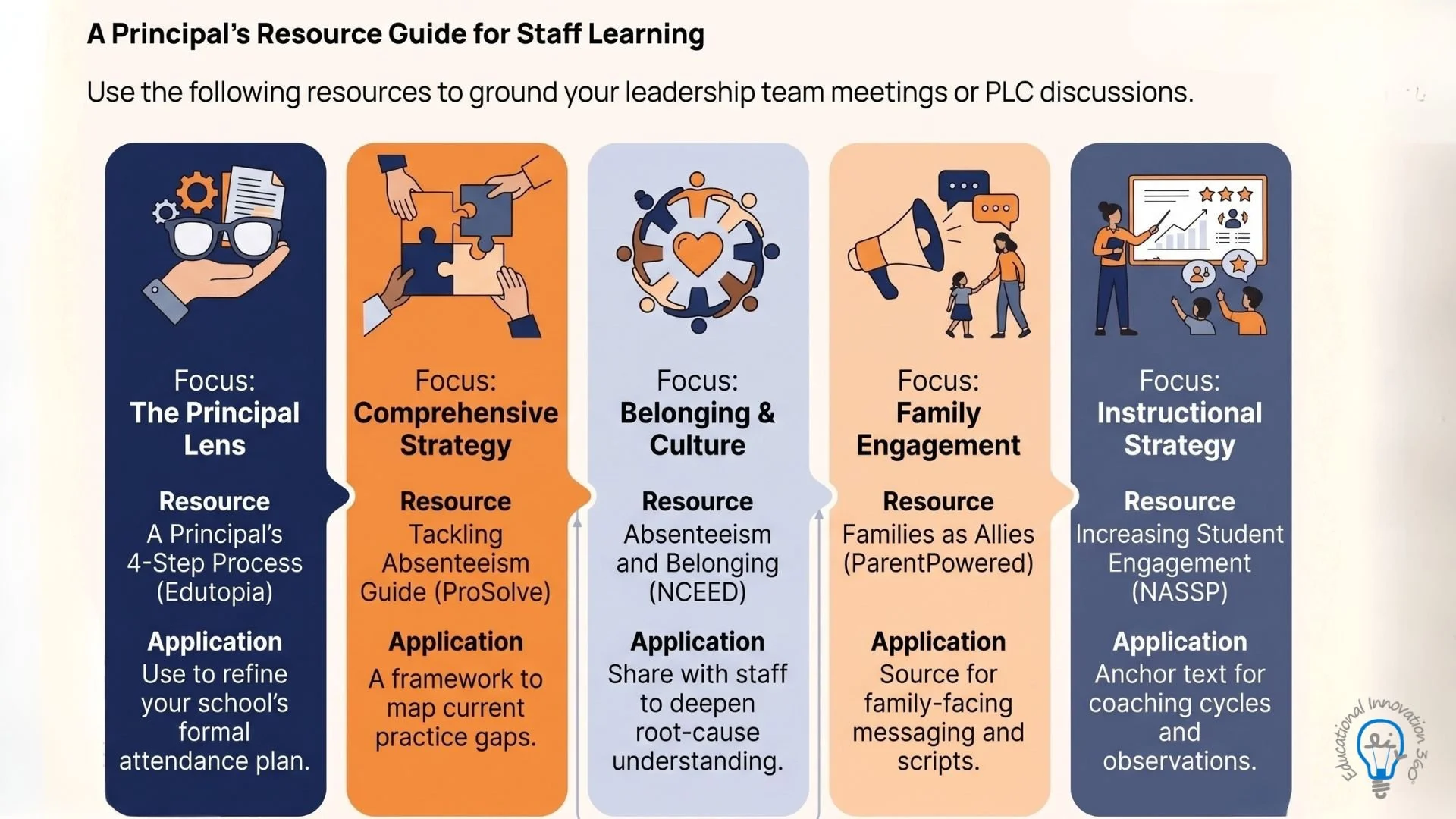
Ei360’s Principal Resource Guide for Learning: Use the following resources to ground your leadership team meetings or PLC discussions.
Do Not Reinvent the Wheel!
As you design your next professional development session or leadership team meeting, don’t reinvent the wheel. Use this curated list to ground your discussions in research and proven practice. Whether you need a full framework to map your strategy or just a few key statistics to drive home the importance of attendance, these resources offer practical, ready-to-use insights. Effective staff learning doesn’t require endless planning; sometimes, it just requires the right anchor text to spark a transformative conversation.
References
Bauer, L., Liu, P., & Schanzenbach, D. W. (2024). K-12 chronic absenteeism rates down from peak, but remain persistently high. The 74 Million.
Dee, T. S. (2023). Higher chronic absenteeism threatens post-pandemic recovery. Policy Analysis for California Education.
Jordan, P. (2026, March 16). A principal’s 4 steps for reducing chronic absenteeism. Edutopia.
National Center for Excellence in Educational Development (NCEED). (2025). Chronic absenteeism, engagement, and a sense of belonging.
ParentPowered. (2025). The chronic absenteeism impact: Engaging families as allies.
PowerSchool. (2025). Tackling K-12 chronic absenteeism from every angle.
ProSolve. (2025). Tackling chronic absenteeism in K-12 education: A comprehensive guide.
Riser-Kositsky, M. (2024). Chronic absenteeism: What it is and why it matters. Education Week.
Vrabic, J. (2026). Effective strategies to increase student engagement. NASSP Principal Leadership.