
How Principals Can Use AI to Improve Instruction and Reduce Teacher Workload
Artificial intelligence is moving from the margins to the mainstream of K–12 leadership and classroom practice, and principals are emerging as the key architects of how AI is used and governed in their schools.
Why AI Is Surging in K–12
Several forces are driving AI’s rapid rise in schools.
Generative AI tools (chatbots, content creators, tutors) became broadly accessible in 2022–23, prompting a wave of experimentation by educators and students.
By 2023–24, over 80% of K–12 teachers reported using generative AI for personal or school-related work, indicating AI is now part of everyday practice rather than a niche innovation.
Surveys show strong leadership engagement: about 58–60% of principals report using AI tools for their own work, and roughly two‑thirds of school leaders encourage staff to use AI.
Student use is also climbing; about 70% of high school students reported using AI in the 2023–24 school year, up from 58% the previous year, raising urgent questions about academic integrity and instructional purpose.
In this context, AI is no longer a “future trend” but a core part of school decision-making, teaching, and learning.
How Principals Are Using AI for Instruction
Research and field reports show that principals are not just approving tools; they are modeling and scaffolding AI-supported instruction.
Many leaders use AI to help teachers with lesson planning, unpacking standards, generating lesson outlines, and differentiating tasks and texts.
Educators report using AI heavily for brainstorming, idea generation, and creating teaching materials, with more than half in some surveys doing so for planning and resource development.
Principals describe guiding teachers to use AI to generate classroom activities, develop assessments, build IEP goals, and differentiate student resources, positioning AI as a co-planner rather than a replacement for professional judgment.
Some leaders also deploy AI to create leveled texts or substitute plans when teachers are absent, ensuring continuity of instruction while maintaining oversight of content quality.
When principals frame AI as an assistive tool, accelerating routine work while preserving teacher expertise, they help maintain instructional rigor alongside innovation.
AI for Tutoring and Personalized Support
Beyond planning, schools are adopting AI to personalize learning and expand tutoring-like support.
AI-powered tutoring systems can provide adaptive practice, immediate feedback, and just-in-time explanations, which are especially valuable for students who need more opportunities to rehearse skills.
Districts are contracting with vendors offering student-focused tools, including adaptive tutoring, automatic writing evaluation, and curriculum-aligned chatbots that turn assignments into interactive activities and produce real-time performance data.
Early surveys indicate that about one‑third of teachers are already using AI to personalize learning, and many report perceived gains in student engagement and productivity.
Best practices emerging from these implementations emphasize pairing AI feedback with teacher conferencing so that technology amplifies, not replaces, human relationships and formative assessment.
AI in School Operations and Data Use
Principals are also leveraging AI behind the scenes to run schools more efficiently and strategically.
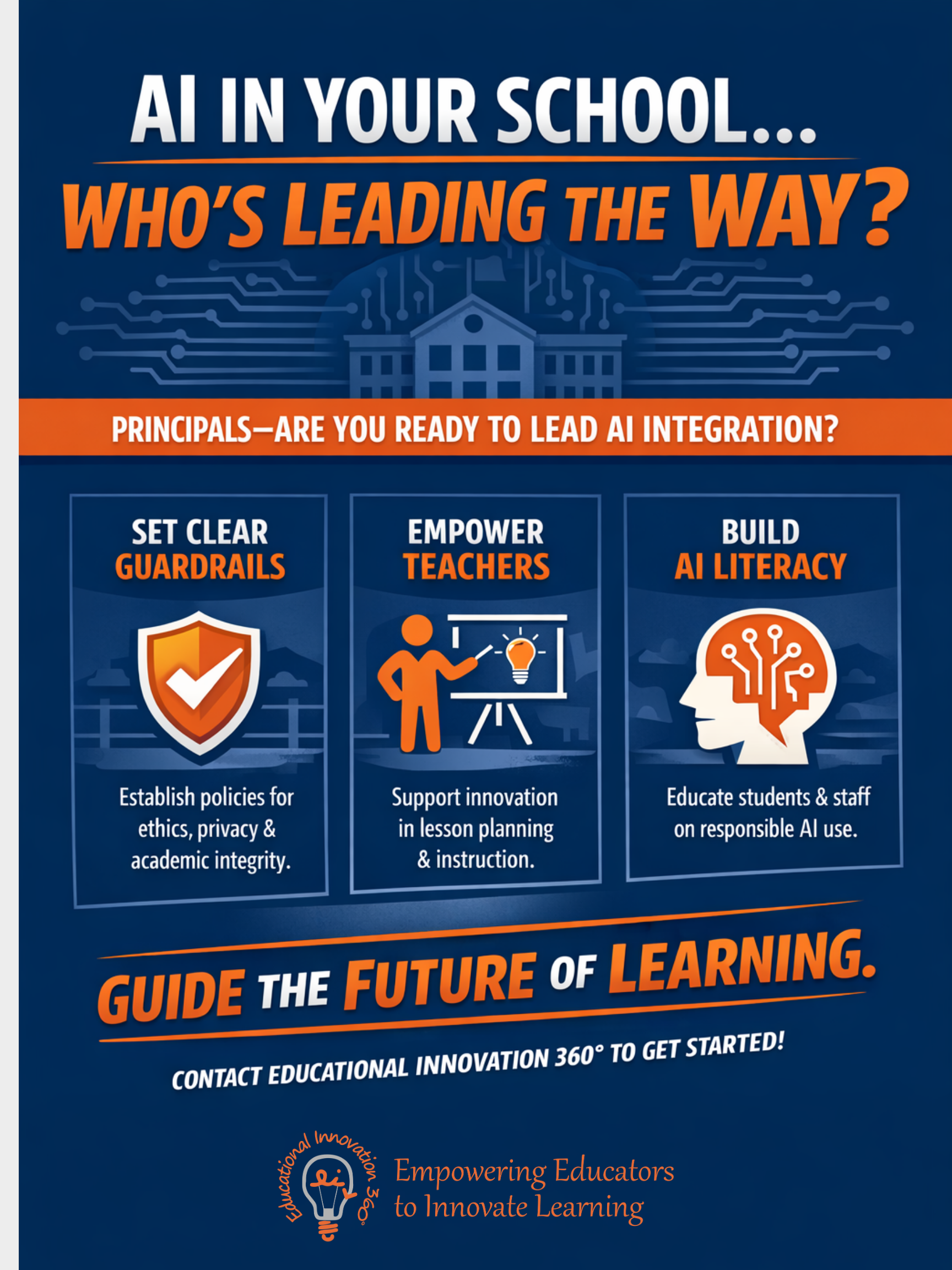
Ei360: AI in Your School Who’s Leading the Way
A growing share of principals (around 60%) use AI for administrative tasks like drafting communications, summarizing meeting notes, and creating professional learning materials.
AI tools are being piloted to streamline operations such as scheduling, attendance tracking, communications, and identifying at-risk students through integrated data systems.
Some districts are building “data lakes” that centralize information from multiple systems, laying the groundwork for AI-driven analytics to support districtwide performance monitoring and decision-making.
These uses can free leaders’ time for instructional leadership, but they also demand new capacity in data literacy, privacy, and vendor management.
What are the three typical AI uses?
Focus area: Typical AI uses. Example insights. Instruction. Lesson planning, resource generation, and differentiating texts and tasks. Faster planning cycles; more time for formative feedback and coaching. Student support: Adaptive tutoring, writing support, targeted practice. More personalized learning paths, especially in core subjects, operations scheduling, communications, data dashboards, and risk flagging. Improved efficiency and more real-time data for decisions
Academic Integrity, Policy, and Digital Citizenship
As AI use grows, principals must simultaneously safeguard academic honesty and student well-being.
Schools are beginning to articulate AI-specific academic integrity expectations, distinguishing between acceptable support (idea generation, editing) and misconduct (submitting AI-generated work as one’s own).
Some districts explicitly tie AI use to the core values of academic integrity, honesty, trust, fairness, respect, and responsibility, and stress that AI should deepen learning rather than shortcut it.
Surveys show only about a third of schools currently have a formal AI policy for students, even though a majority view AI education as a top priority and encourage staff use, revealing a policy gap leaders are now racing to close.
Emerging best practice is to embed AI ethics and responsible use into digital citizenship curricula, teaching students to evaluate AI outputs critically, acknowledge assistance, and reflect on whether they actually learned the content.
When schools treat AI literacy and integrity as instructional goals and not just compliance issues, they equip students to navigate AI-rich futures with agency and character.
Best Practices for Principals Leading AI Implementation
Current research and field experience suggest several action steps for school leaders.
Start with a vision and guardrails
Define how AI supports your instructional priorities (e.g., feedback, differentiation, reducing busywork) and what non-negotiables protect equity, privacy, and integrity.
Establish clear, tiered guidelines for staff and students: where AI is encouraged, where it is restricted, and when human review is mandatory.
Co‑design policies with stakeholders
Involve teachers, students, families, and IT/legal staff in drafting AI use policies and academic honesty frameworks to build shared understanding and buy-in.
Communicate openly about both the benefits and risks of AI, including data security and bias concerns.
Invest in professional learning and AI literacy
Provide ongoing PD on using AI for lesson design, differentiation, and assessment design, not just one-off tool demos.
Develop teacher and student AI literacy: how systems work, where they can be wrong or biased, and how to use them as thinking partners rather than answer engines.
Pilot, evaluate, then scale
Begin with small pilots in high-impact use cases (e.g., lesson planning, targeted tutoring, data dashboards) and collect data on educator workload, student outcomes, and perceptions.
Use mixed methods, including usage data, surveys, and focus groups, to decide which tools to expand, modify, or sunset.
Center equity and student voice
Monitor whether AI-supported tools are equitably accessible and whether they mitigate or widen gaps in opportunity and outcomes.
Engage students in discussions about ethical AI use and invite their feedback on how AI affects their motivation, sense of ownership, and understanding.
Artificial intelligence and new digital tools are quickly becoming central to how principals design instruction, manage operations, and cultivate a culture of integrity in their schools. Leaders who approach AI with a clear vision, robust policies, and a commitment to ethical, student-centered practice will shape not only how their schools use AI but also how their students learn to live and lead with it.
Reference:
U.S. Department of Education, Office of Educational Technology. (2023). Artificial intelligence and the future of teaching and learning: Insights and recommendations. U.S. Department of Education.
Mahnken, K. (2025, January 14). Student, teacher AI use continued to climb in 2023-24 school year. K-12 Dive.
Sparks, S. D. (2024, September 29). AI and education 2024: Educators express mixed feelings about technology’s future. EdTech Magazine.
Wallace, K., & Vogels, E. A. (2024, May 14). A quarter of U.S. teachers say AI tools do more harm than good in K–12 education. Pew Research Center.
GovSpend. (2025, September 16). K–12 schools race to adopt AI in an untamed market. GovSpend.
EDspaces. (2025, May 21). How school leaders are using AI to revolutionize operations and procurement: An EDspaces guide for K–12 administrators. EDspaces.
The Think Academy. (2025, October 19). Academic integrity in the age of ChatGPT: How K–12 students can learn to use AI responsibly. The Think Academy.
Veracross. (2025, November 12). Artificial intelligence in K–12 schools: 2025 AI in K–12 report. Veracross.
Gewertz, C. (2025, February 13). Teachers and principals are turning to AI. Here’s how. Education Week.
Austin Public Schools. (2022). Student procedures for generative AI use. Austin Public Schools.