
When Teachers Are the Last to Know: AI in K–12 and the Educator Voice Gap
AI is no longer on its way to K–12 classrooms. It's already here, reshaping how teachers plan lessons, writing feedback, and communicate with families. The question now isn't whether AI will change teaching. It's who gets to shape how that happens. For too many educators, the answer so far has been: not them.
The Adoption Is Real. The infrastructure isn't.
The expedited adoption of generative artificial intelligence (AI) in K–12 classrooms highlights a growing disconnect between innovation and institutional support. Teachers are increasingly integrating AI into their professional practice, yet the infrastructure needed to guide effective and ethical use has not kept pace.
Recent data illustrate the speed of this shift. A national survey found that 63% of K–12 teachers reported that they or their districts had incorporated generative AI into their teaching processes, representing a 12-percentage-point increase from the previous year (Cengage Group, 2024). Informal use appears even more widespread. Another report indicated that 83% of teachers used generative AI tools for personal productivity or classroom-related tasks during the 2023–2024 school year, a 32-percentage-point increase from the previous year (Electro IQ, 2024). These findings suggest that educators are rapidly experimenting with AI to support planning, instruction, and efficiency.
However, widespread use has not been matched with adequate professional learning. During the 2024–2025 school year, 68% of teachers reported receiving no formal training on how to use AI tools, and many of those who do use them have largely taught themselves (The 74 Million, 2024). In practice, this leaves educators navigating issues such as ethics, data privacy, and instructional design without structured guidance.
Policy development has lagged as well. A national content analysis found that as of May 2024, only 14.13% of U.S. school districts had established formal AI policies, leaving most educators without clear frameworks for responsible implementation (Zhou et al., 2025). Together, these findings highlight a central challenge in the current moment: AI adoption in schools is accelerating, but the systems needed to support educators are still emerging.
What Happens When Teachers Are Told, Not Asked
At Educational Innovation 360, we use a simple framework for thinking about educator agency in AI rollout: Told → Asked → Involved → Leading. Most districts are stuck in the first two quadrants.
When AI tools are announced via email or dropped into a one-day PD, teachers are TOLD. When they complete feedback surveys that don't visibly shape anything, they're ASKED. The decisions about what to buy, what problems to solve, and what success looks like have already been made, often by someone else.
This pattern carries real costs. When teachers aren't part of defining the problem, solutions tend to miss the actual instructional and equity challenges they face. And when concerns go unheard, trust erodes. While K–12 teachers' concerns about AI's impact on academic integrity remain high at 83%, concerns about data privacy are increasing, up 4 points year over year, according to Cengage Group. These aren't abstract worries. They reflect what teachers observe in classrooms every day. Systems that ignore this intelligence lose the informed, on-the-ground feedback that makes any tool worth using.
The procurement data make the fragmentation visible. According to public purchase order data, more than 850 unique U.S. school districts collectively purchased over $5 million in AI tools within a recent six-month window, yet only a handful issued formal RFPs for those tools. .
What It Looks Like When Teachers Lead
Some districts are doing this differently. In one large district profiled in a 2025 EdTech Digest feature, leadership invested in a train-the-trainer model that created over 200 school-based AI teacher leaders and educators who participated in deep professional learning on AI fundamentals, safety, and instructional design, then led capacity-building in their own schools. AI decisions were made with teachers at the table, not after tools were already purchased.
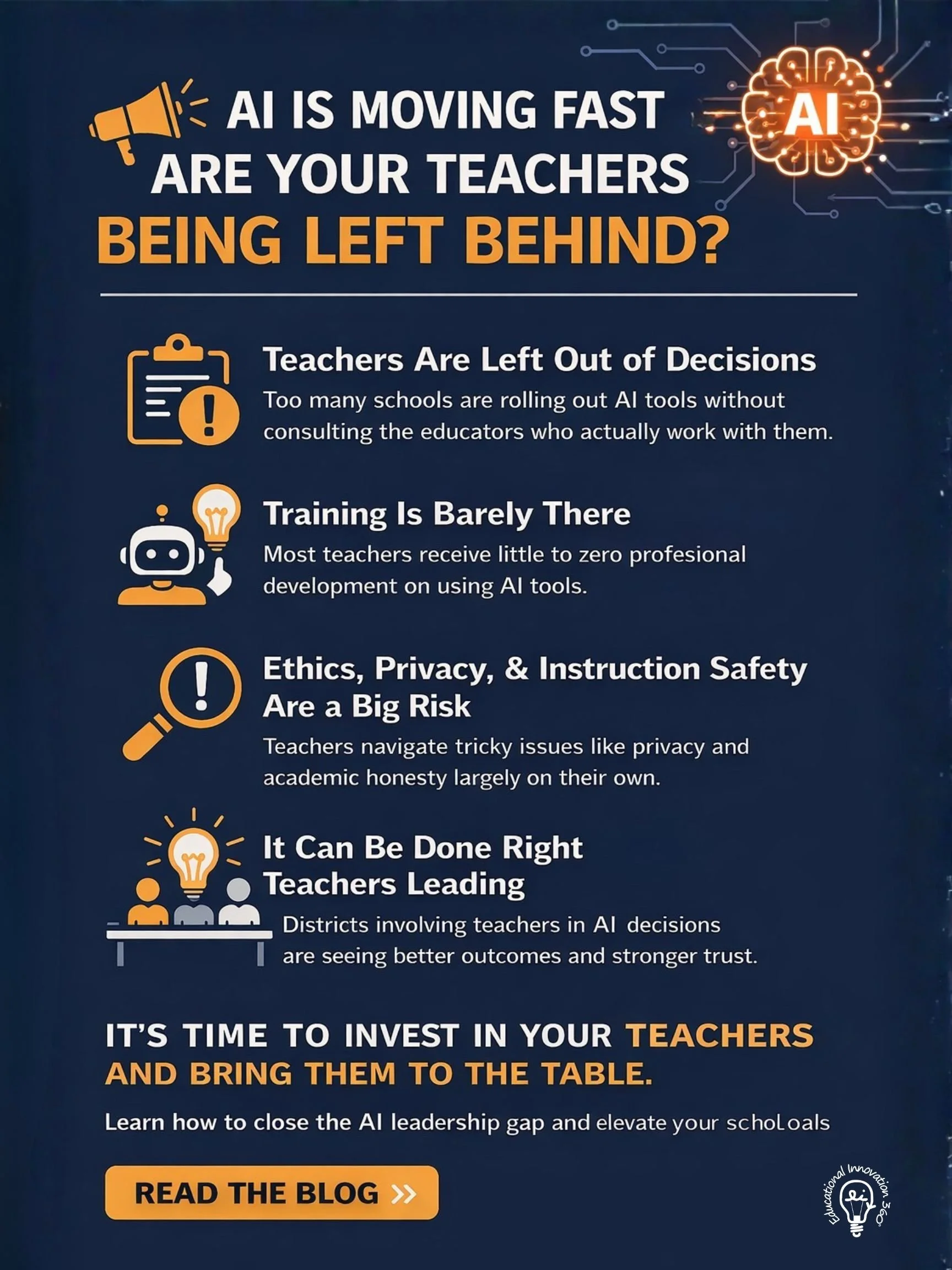
When teachers move from being informed after the fact to co-defining what success looks like, tools get used better, concerns get addressed earlier, and the professional trust that drives any real change becomes possible to build. At the state level, some systems are creating the infrastructure for this kind of coordinated, teacher-informed rollout.
By mid-2025, 26 states plus Puerto Rico had published official AI guidance for K–12 schools. SchoolAI states that states like Utah and North Carolina have gone further by hiring AI specialists, negotiating statewide contracts, and building professional development frameworks that schools can access without starting from scratch. AI has become the leading state edtech priority, ahead of broadband and cybersecurity, according to SETDA's 2025–26 State EdTech Trends report.
The question for every district right now is whether their AI work is building something, a coherent policy, shared norms, genuine teacher agency, or just accumulating tools.
The Reading Lens
At Educational Innovation 360, our work lives inside one central question every day: How do we ensure innovation actually strengthens teaching and learning rather than complicating it? This question shows up most clearly in our work with reading instruction and teacher development. What we are seeing in AI rollouts mirrors a pattern we have observed for years in curriculum adoption. When teachers are not consulted during implementation, even strong tools are used inconsistently, and it is often the students who need the most support who feel the consequences of that inconsistency.
This issue is more than a technical conversation about new tools. It is imperative because we are responsible for supporting the next generation of students and the next generation of teachers who will guide them. The decisions schools make today about AI, instructional support, and teacher development will shape classrooms for years to come. That is why we care so deeply about this topic. In fact, we recently presented on this issue at SXSW, where educators, researchers, and technology leaders came together to examine how AI is reshaping learning environments.
In our work with schools, we see clear evidence that real-time, personalized coaching feedback is one of the most powerful drivers of improved reading outcomes. When teachers receive targeted support on specific instructional moves, especially those connected to literacy instruction, students benefit. AI has the potential to extend that kind of support by helping teachers access faster, more precise feedback that strengthens daily instructional practice.
However, that potential only becomes real if teachers trust the tools, understand how they work, and have a voice in shaping how they are implemented. Without that partnership, even the most promising technology struggles to deliver meaningful impact. For the classrooms we serve, when teachers are empowered, supported, and included in the design of innovation, the tools become stronger, the instruction becomes sharper, and students receive the consistent support they deserve.
References
Cengage Group. (2025, April 3). AI in education report: New data shows growing GenAI adoption in K-12 and higher education [Press release]. https://www.cengagegroup.com/news/press-releases/2025/
Eutsler, L., & Cummings, J. (2025). Artificial intelligence policies in K-12 school districts in the United States: A content analysis shaping education policy. Journal of Research on Technology in Education. https://doi.org/10.1080/15391523.2025.2476589
GovSpend. (2025, September 16). K-12 schools race to adopt AI in an untamed market. https://govspend.com/blog/k-12-schools-race-to-adopt-ai-in-an-untamed-market/
Pew Research Center. (2024, May 15). A quarter of U.S. teachers say AI tools do more harm than good in K-12 education. https://www.pewresearch.org/
SETDA. (2026). 2025 state edtech trends: Leadership, technology, innovation, learning. https://www.setda.org/
Walton Family Foundation & Gallup. (2025, June 25). Teaching for tomorrow: Unlocking six weeks a year with AI. https://www.waltonfamilyfoundation.org/