
How Ditching Candy Rewards Can Supercharge Elementary Learning
Many elementary classrooms still rely on candy, prizes, and points to manage behavior and motivate learning. While these strategies can produce short-term compliance, research consistently shows they can undermine students’ long-term motivation, independence, and engagement. Classrooms grounded in relationships, authentic choice, and process-focused feedback foster stronger and more durable learning than those dependent on treats and trinkets.
The “Treat Trap” in Motivation Research
Psychologists describe this phenomenon as the overjustification effect: when students receive expected, tangible rewards for tasks they might otherwise enjoy, their intrinsic motivation often declines. A landmark meta-analysis by Deci, Koestner, and Ryan (1999) found that rewards such as candy or prizes significantly reduced students’ interest in tasks once the rewards were removed, often below their original level of engagement.
Not all feedback is harmful. Recognition that communicates competence and growth, rather than control, can support motivation when students perceive it as information about their learning rather than a means of compliance. However, token economies and prize systems often shift students’ focus from curiosity, persistence, and self-regulation to “What do I get?” Instead.
Why Treat-Based Systems Persist
Despite well-documented drawbacks, food and trinket rewards remain common. These practices raise equity and health concerns, can exclude students with dietary needs, and may condition children to associate learning with external payoffs. Behaviorist systems like clip charts and point tallies can also contribute to anxiety, shame, and reduced risk-taking, especially for students who rarely “win.” Over time, teachers carry the burden of constant monitoring and reinforcement, increasing emotional labor and burnout.
What Works Better: Relationship-Centered Structures
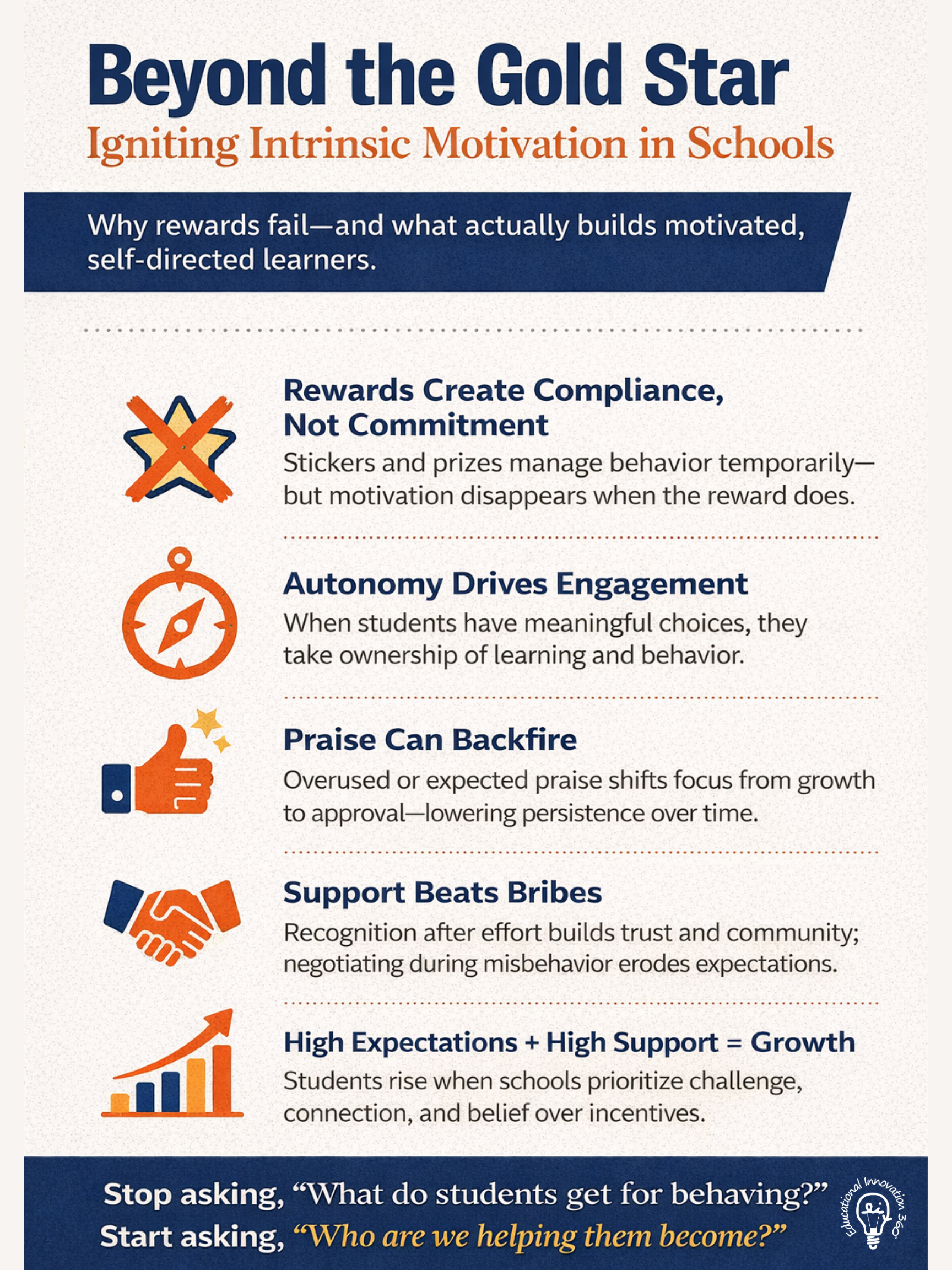
Ei360: Beyond the Gold Star
Relationship-based approaches, such as Responsive Classroom, emphasize clear routines, respectful teacher language, and student responsibility over external rewards. Research shows these practices improve classroom climate, student engagement, and academic outcomes while reducing reliance on prizes (Center for Responsive Schools, 2025). Teachers also report greater satisfaction when motivation is built into routines and relationships rather than managed through constant incentives.
Engagement Without Candy: Must Do / May Do
Self-paced Must Do / May Do structures offer a practical alternative. Students complete required tasks, then choose from meaningful extension activities: art, inquiry, collaboration, or games. Research on autonomy-supportive teaching shows that structured choice increases persistence, conceptual understanding, and engagement. To be effective, May Do options must be genuinely interesting, Must Do tasks must be achievable, and students should be taught how to manage time and reflect on effort. In this model, motivation is embedded in the learning design and not handed out as a treat.
Feedback That Builds Effort, Not Dependence
Process-focused feedback supports a growth mindset, helping students persist through challenges. Studies by Dweck and colleagues show that praising effort, strategies, and revision, rather than intelligence or outcomes, leads to greater resilience and willingness to take academic risks (Mueller & Dweck, 1998; Dweck, 2000). Over time, students learn to value progress itself, reducing reliance on external rewards.
Social Recognition Over Snacks and Bribes vs. Purposeful Rewards
Simple social rewards, specific praise, quiet notes, and acknowledgment tied to classroom values can be powerful motivators. Research suggests social recognition supports performance and belonging without the controlling effects of tangible rewards when delivered intentionally and respectfully.
A key distinction matters: bribes are reactive incentives offered to stop misbehavior (“If you sit down, I’ll give you candy”), while healthier rewards are planned, skill-based, and gradually faded. Motivation research shows that controlling rewards reduces autonomy, while systems that emphasize effort, clarity, and internalization are more sustainable (Deci et al., 1999). A helpful reflection for teachers is: Will this strategy still work when I’m not offering something? If not, it’s likely reinforcing dependence rather than growth.
Supporting Teachers, Too so the Bottom Line is…
At Educational Innovation 360, we know that motivation is influenced by factors beyond the classroom, and teachers cannot, and should not, carry sole responsibility for student engagement. Designing motivating environments, teaching self-reflection, and sharing ownership with students support both learner development and teacher well-being. Sustainable motivation practices reduce burnout and shift classrooms away from constant performance management toward shared responsibility. So, when teachers reduce reliance on treats, prioritize relationships, and design structures that build autonomy and competence, students develop more durable motivation, and teachers reclaim energy for teaching instead of constant incentivizing. This is about building learning environments that last.
References
Deci, E. L., Koestner, R., & Ryan, R. M. (1999). A meta-analytic review of experiments examining the effects of extrinsic rewards on intrinsic motivation. Psychological Bulletin, 125(6), 627–668.
Dweck, C. S. (2000). Self-theories: Their role in motivation, personality, and development. Psychology Press.
Mueller, C. M., & Dweck, C. S. (1998). Praise for intelligence can undermine children’s motivation and performance. Journal of Personality and Social Psychology, 75(1), 33–52.
Center for Responsive Schools. (2025). Our approach.