
How Principals Can Lead AI Integration Without Overwhelming Teachers
Artificial intelligence is shaping classrooms faster than most schools can keep up with. Districts are pushing forward with new expectations, states are updating standards, and vendors are crowding inboxes with promises that AI will solve every problem. Yet the principal’s challenge remains steady: support teachers, protect instructional quality, and keep the building running smoothly.
AI can be a powerful tool for instructional leadership, but only if principals introduce it in a way that reduces stress instead of adding new burdens. The goal is not for everyone to become a tech expert. The goal is to help teachers work smarter, create more personalized learning experiences, and free up time for what matters most students.
Why Principals Feel the Pressures Around AI
Recent surveys show that leaders are optimistic about AI but unsure how to implement it responsibly. According to the 2024 State of K-12 EdTech Report, principals want guidance that is practical, ethical, and teacher-centered (LearnPlatform, 2024). Teachers echo the same concerns, with large majorities reporting anxiety about workload increases, privacy issues, and unclear expectations from leadership (RAND Corporation, 2023).
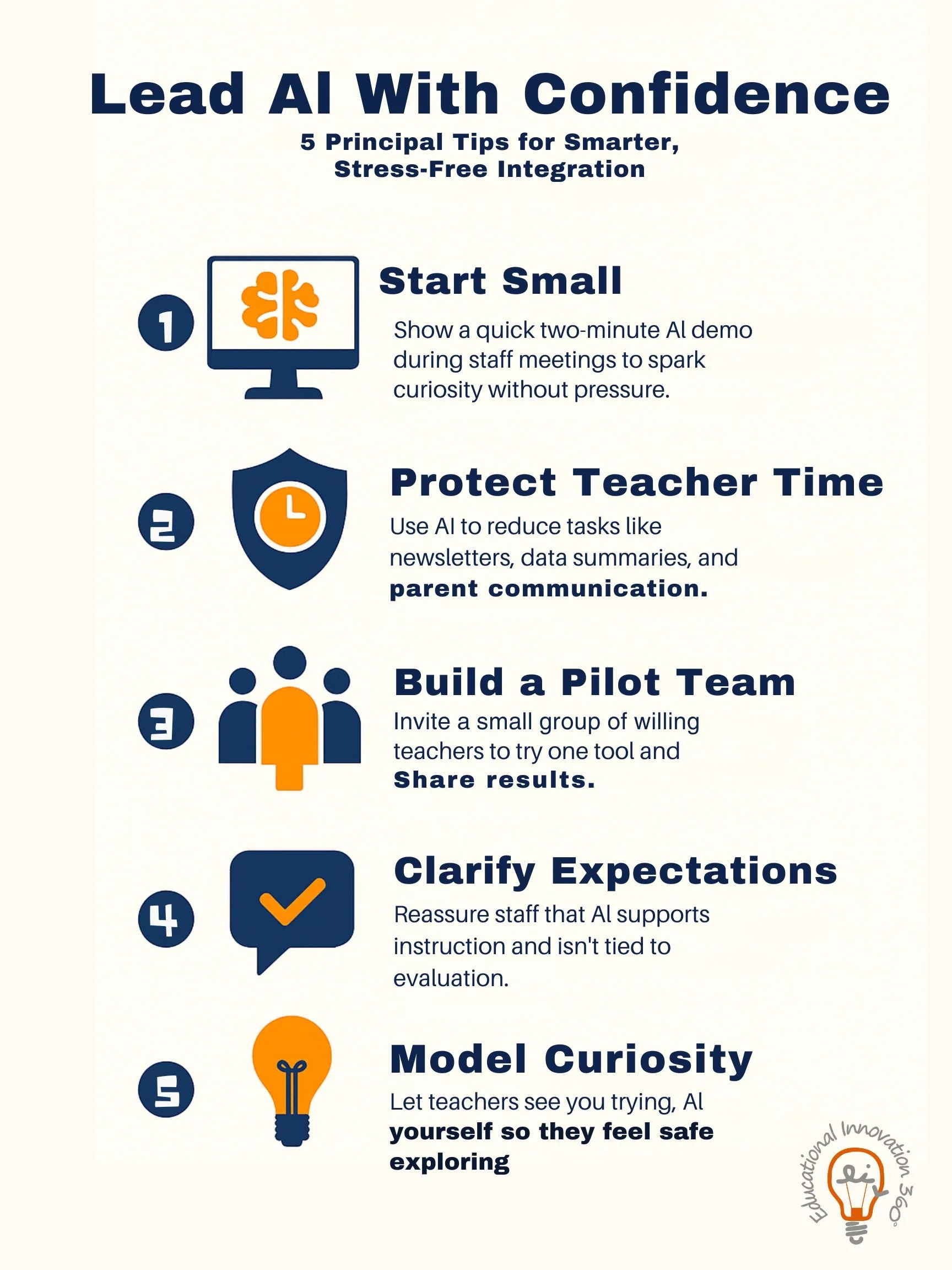
Ei360: Lead AI with Confidence
Principals sit at the crossroads. They’re expected to move the school forward while protecting the well-being of their staff. This tension makes AI feel complicated not because of the technology itself, but because of the people dynamics surrounding it.
Start With Low-Lift, High-Impact Actions
Principals don’t need a large-scale rollout to start building momentum. The most successful AI integration strategies begin with small, visible wins that build trust.
1. Use short demonstrations during staff meetings
A simple two-minute demonstration of an AI tool that:
Rewrites a family newsletter
Generates differentiation ideas
Summarizes student data trends
This can reduce fear and spark curiosity. Short demos keep the tone light rather than evaluative.
2. Create small pilot groups
Research on school innovation shows that pilot teams reduce resistance and increase buy-in (Fullan, 2020). Invite a few teachers to test one tool for four to six weeks, then share insights with colleagues. When teachers lead the conversation, your staff feels empowered, not pushed.
3. Redesign one school-wide process with AI
Choose something everyone benefits from:
A cleaner behavior data summary
Faster PD planning
Improved communication templates for family outreach
When teachers see AI saving you time, they trust that it will help them as well.
Protect Teachers From Overload
AI must be positioned as a support, not a surveillance tool. Teachers are more willing to try new technology when expectations are clear and boundaries are respected.
Set the tone with reassurance
Use phrasing such as:
“AI is here to reduce your task load, not evaluate your teaching.”
“We will move at a pace that makes sense for our staff and our students.”
Clear messaging reduces the cognitive load that often accompanies change initiatives.
Avoid one-size-fits-all rollouts
Teachers vary in comfort and readiness. Diffusion of Innovation Theory reminds us that early adopters pull others forward through modeling, not mandates (Rogers, 2003). Your leadership should honor this natural progression.
Provide realistic expectations
Teachers should never feel obligated to incorporate AI into every lesson. Focus on areas where it immediately helps, such as:
Planning
Communication
Data interpretation
Scaffolds for multilingual learners
When they feel control rather than pressure, adoption grows organically.
Quick Wins Principals Can Implement Right Now
These examples require minimal training and demonstrate immediate payoff.
AI for parent communication
Drafting clearer messages
Translating newsletters
Offering multiple tone options for sensitive communication
AI for planning professional development
Summarizing observation trends
Generating PD agendas
Creating follow-up action steps
AI for analyzing discipline patterns
Spotting disproportionality
Highlighting time-based or location-based trends
Offering early-intervention patterns
These tasks save significant time, helping you model the very efficiency you want for your teachers.
Adopt a Leadership Mindset That Supports Innovation
Your staff watches how you approach change. They follow your cues on whether AI is an opportunity or a threat.
Model curiosity
Leaders who show open-mindedness toward learning build staff confidence. Curiosity reduces fear and increases psychological safety a key factor in teacher willingness to innovate (Edmondson, 2019).
Reward experimentation
Celebrate small attempts rather than polished outcomes. Even a simple, “Thanks for trying something new this week,” reinforces a growth mindset.
Encourage small steps
Effective change happens through incremental improvement, not sweeping transformation. When teachers know they can start small, they engage more fully.
Conclusion
AI integration does not have to overwhelm your staff or disrupt the core mission of your school. When introduced with clarity, empathy, and practicality, AI becomes a tool that strengthens your leadership and gives teachers the support they deserve. The principal’s role is not to master every tool, but to guide a process that lifts the entire learning community. With thoughtful planning, you can lead your school into the next phase of innovation with confidence and care.
References
Edmondson, A. (2019). The fearless organization. Wiley.
Fullan, M. (2020). The new meaning of educational change (5th ed.). Teachers College Press.
LearnPlatform. (2024). State of K-12 edtech report.
RAND Corporation. (2023). Educator perspectives on AI in schools: Findings from the American Teacher Panel.
Rogers, E. (2003). Diffusion of innovations (5th ed.). Free Press.