
The Principal's Playbook for Raising Achievement in Literacy and Math
Student achievement and learning gaps are two sides of the same coin. Achievement improves when we systematically:
Ensure strong, grade-level core instruction for every student.
Identify unfinished learning early with high-quality assessments.
Provide timely, tiered intervention matched to specific skill gaps.
Monitor progress and adjust supports.
A multi-tiered system of supports (MTSS) offers a framework for doing this at scale: Tier 1 for high-quality core instruction, Tier 2 for targeted small-group support, and Tier 3 for intensive, individualized intervention (Kansas MTSS & Alignment, 2026). When implemented well, MTSS is associated with improved academic outcomes and reductions in exclusionary discipline.
For principals, the challenge is less “what works” and more “how to organize the work.” The rest of this post focuses on practical moves you can make.
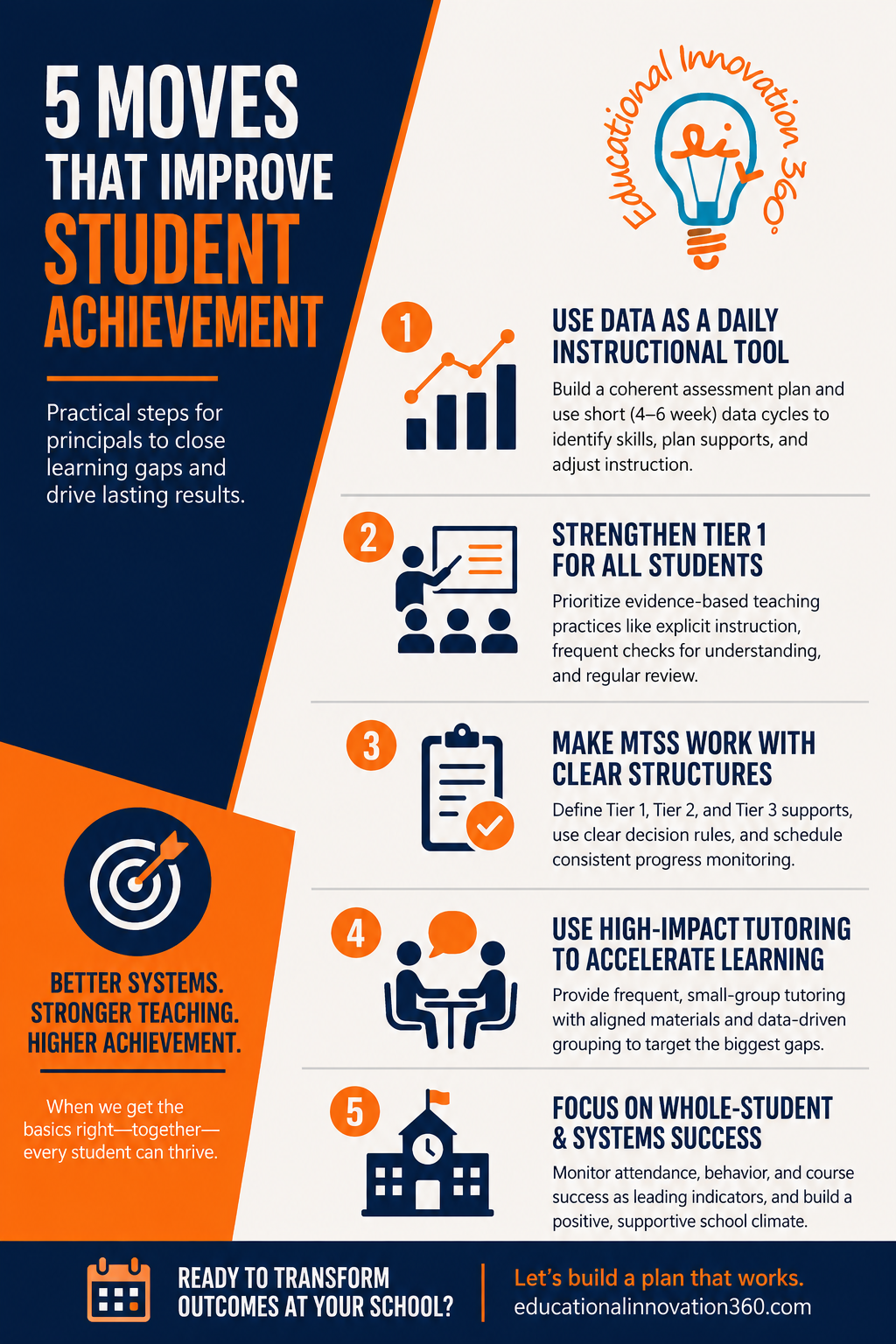
Ei360: Five Moves that Improve Student Achievement
Use Data as a Daily Instructional Tool, Not a Quarterly Event
Data improves achievement only when it drives timely instructional decisions. That requires a shift from compliance-driven data routines to instructional data cycles.
1. Build a coherent assessment plan
Principals can start by mapping an assessment system that:
Uses universal screeners in literacy and math (3–4 times per year).
Incorporates curriculum-embedded formative assessments weekly.
Limits redundant tests and clarifies the purpose of each assessment.
Evidence shows that formative assessment; ongoing checks for understanding and feedback, produces meaningful gains in student achievement when teachers use it to adjust instruction.
Leader move: Create a one-page “Assessment & Data Use Guide” for your school: What we assess, when, who is responsible, and how results will be used instructionally (e.g., regrouping students, reteaching standards, adjusting pacing).
2. Establish short, focused data cycles
Rather than waiting for benchmark windows, use 4–6 week cycles:
Identify priority standards and skills based on recent data.
Plan targeted instruction and interventions.
Implement supports (Tier 1, Tier 2, Tier 3).
Re-assess and refine.
Research on MTSS recommends systematic review of multiple data sources (screeners, progress monitoring, behavior, attendance) to match interventions to students’ needs and monitor effectiveness (Kansas MTSS & Alignment, 2026).
Leader move: Schedule standing grade-level or department data meetings every 4–6 weeks. Provide protocols so teams focus on:
Which standards/skills are most problematic?
Which students need Tier 2 vs. Tier 3?
What specific instructional strategies or interventions will we use next?
Strengthening Tier 1: Evidence-Based Instruction for All:
You cannot “intervention” your way out of weak core instruction. The biggest gains come when Tier 1 is consistently effective and aligned to evidence-based practices.
3. Promote high-impact teaching routines
Decades of research on effective teaching highlight practices such as explicit instruction, guided practice, frequent checks for understanding, and distributed review (Rosenshine, 2012; summarized in “Evidence-based teaching practices”).
Key elements include:
Presenting new material in small, well-sequenced steps.
Modeling thinking and problem-solving (“think-alouds”).
Guiding practice with questioning and feedback.
Ensuring high success rates (~80%) during practice to reduce errors.
Providing scaffolds for complex tasks.
Scheduling regular review of previously taught content.
These practices are linked to improved achievement across subjects and grade levels, particularly when implemented consistently.
Leader moves:
Select 2–3 instructional “non-negotiables” (e.g., daily checks for understanding, think-aloud modeling) based on evidence, and embed them into coaching cycles, walkthrough tools, and PLC agendas.
Use short, focused classroom walk-throughs to look specifically for explicit teaching steps and checks for understanding, then provide rapid feedback tied to those practices.
4. Ensure curriculum alignment and access to grade-level work
Evidence-based instruction depends on high-quality, standards-aligned materials. Research on closing achievement gaps emphasizes aligning instruction with grade-level expectations while providing scaffolds and supports rather than relying on long-term remediation.
Leader moves:
Audit grade-level lessons: Are students regularly working with complex texts and rigorous math tasks, or mostly in low-level skills practice?
Use MTSS to organize supports so students receive “core plus more” keeping them engaged in grade-level content while addressing specific skill gaps in parallel.
Making MTSS Work: Structures, Not Slogans
MTSS is most powerful when it is a lived system with clear roles, schedules, and routines; not just a flowchart.
5. Clarify tiered supports and decision rules
Effective MTSS plans describe:
Tier 1: High-quality, evidence-aligned core instruction for all students, with differentiation and scaffolds.
Tier 2: Supplemental small-group support (typically 3–5 students) targeting specific gaps, delivered multiple times per week.
Tier 3: Intensive, often 1:1 or very small group, with highly explicit instruction delivered frequently and monitored with weekly progress measures.
Research indicates that properly implemented MTSS can reduce behavior incidents and increase academic success by systematically matching support intensity to student needs (Kansas MTSS & Alignment, 2026).
Leader moves:
Develop written entry/exit criteria for each tier (e.g., benchmark cut scores, rate of progress).
Create a master schedule that protects intervention blocks (e.g., “WIN” time, What I Need) and ensures that students receiving Tier 2 and Tier 3 support are not routinely missing core instruction.
6. Prioritize progress monitoring and intervention fidelity
Strong MTSS systems use frequent progress monitoring to determine whether interventions are working. Reviews of MTSS and RTI highlight that inconsistent implementation and lack of fidelity checks often undermine effectiveness.
Leader moves:
Require brief progress monitoring for Tier 2 and Tier 3 students (weekly or bi-weekly), using curriculum-based measures in reading and math.
Use a simple “intervention integrity checklist” principals or coaches can use during observations: Is the intervention being delivered at the right frequency, group size, and duration using the intended materials?
High-Impact Tutoring: Your Leverage Point for Literacy and Math Gains
The research base on tutoring is among the strongest in education. Reviews of nearly 200 studies find that high-impact tutoring one-on-one or very small group instruction provided several times per week—can significantly improve math and reading outcomes.
7. Design tutoring programs for impact, not just coverage
Effective tutoring programs have common features:
Frequent sessions (3+ times per week).
Small tutor–student ratios (ideally 1:1 to 1:3).
Alignment with core curriculum and classroom learning.
Use of formative assessment to adjust instruction.
Strong tutor–student relationships and consistent tutors over time.
Studies show that such programs can substantially improve achievement, particularly for students from low-income backgrounds (Robinson et al., 2021).
Leader moves:
Schedule tutoring during the school day when possible, which research suggests increases participation and effectiveness.
Focus tutoring on high-leverage skills (foundational reading skills, problem solving and conceptual understanding in math) and align materials with your adopted curriculum.
Track tutoring dosage (minutes per week) and progress so you can demonstrate impact on benchmark scores and course pass rates.
8. Integrate tutoring with MTSS and core instruction
Tutoring is most effective when it is not “off to the side” but integrated into MTSS:
Use data to identify students for Tier 2 and Tier 3 tutoring.
Ensure tutors have access to teachers’ pacing guides and assessments.
Build quick communication loops between tutors and classroom teachers.
High-impact tutoring research emphasizes alignment with classroom instruction and data-informed practices as critical design principles.
Leader moves:
Create a short “tutor briefing template” teachers complete weekly: key standards for the week, common errors, vocabulary, and priority students.
Include tutoring staff in MTSS data meetings so they help interpret progress monitoring and adjust intervention plans.
Connecting Strategies to Graduation Outcomes
While literacy and math are immediate priorities, principals must also keep an eye on graduation. Research and policy analyses show that early warning indicators—attendance, behavior, and course performance in core subjects—are strong predictors of graduation.
By integrating these indicators into MTSS:
Tier 1: Universal supports for engagement, culturally responsive teaching, and positive school climate.
Tier 2: Check-in/check-out systems, small-group SEL, targeted credit recovery for students who fail a core course.
Tier 3: Wraparound supports with counselors, social workers, and community partners.
Tutoring and intensive academic interventions can be strategically aimed at gatekeeping courses (Algebra I, 9th-grade English) that heavily influence graduation trajectories. High-impact tutoring in math and reading is associated with higher course pass rates, which contribute to improved graduation rates over time.
Leader moves:
Create “gateway course” dashboards tracking pass rates, tutoring participation, and intervention supports.
Use summer and intersession tutoring to support students at risk of course failure.
Implementation Playbook for Principals
To move from ideas to action, consider this streamlined implementation sequence:
Clarify vision and non-negotiables.
Identify 2–3 evidence-based instructional practices and commit to embedding them schoolwide.Map and simplify your assessment system.
Align assessments with decision points: screening, instructional grouping, intervention entry/exit, and progress monitoring.Design your MTSS schedule and roles.
Protect intervention blocks, define Tier 2 and Tier 3 entry criteria, and assign roles for data meetings and intervention oversight.Launch or refine a high-impact tutoring program.
Start with a manageable set of grades or courses, ensure high dosage and alignment, and use progress data to refine.Monitor, communicate, and adjust.
Share data trends with staff and families, celebrate gains, and use MTSS and tutoring data to fine-tune supports.
When principals lead this work intentionally, treating data as a daily tool, MTSS as a living system, tutoring as a precision instrument, and instruction as the core driver; schools can both raise achievement and close persistent gaps.
References
Kansas MTSS & Alignment. (2026). 8 steps to developing an MTSS plan.
Kansas MTSS & Alignment. (2025). Discovering the future of MTSS frameworks.
National Council on Teacher Quality. (2025, March 24). High-impact tutoring: Five ways to increase effectiveness.
Robinson, C. D., et al. (n.d.). High-impact tutoring: State of the research and priorities.
Rosenshine, B. (2012). Principles of instruction: Research-based strategies that all teachers should know. Summarized in Evidence-based teaching practices.
Edutopia. (2024, June 5). 8 ways to close the achievement gap in schools.hanoverresearch
Center for Education Policy Research. (2024, October 26). Design principles for accelerating student learning with high-impact tutoring.edresearchforaction
National Center for Education Statistics / various sources. Tutoring research summaries.livehandbook+1
Various authors. (2024, February 17). 10 examples of evidence-based instructional strategies.clickvieweducation
RTI / MTSS implementation resources. Closing learning gaps – Best Practices at Tier 2.