
Before the First Bell Rings: The Principal's July Checklist for Building a School Ready for Success
Every successful school year begins long before students walk through the front doors. While August often brings excitement and urgency, July provides something even more valuable: time to think strategically. or school leaders, July is an opportunity to shift from reacting to last year's challenges to intentionally designing the conditions for student success. High-performing principals understand that exceptional schools are built through thoughtful planning, strong relationships, and systems that support both teachers and students (BetterLesson, 2024; Student Achievement Solutions, 2023).
Whether your priorities include improving literacy achievement, strengthening teacher retention, increasing student engagement, or implementing artificial intelligence responsibly, the work begins now. The decisions made during the summer establish the instructional direction, school culture, and leadership practices that will influence every classroom throughout the year (Learning Policy Institute, 2023; Shultz, 2017).
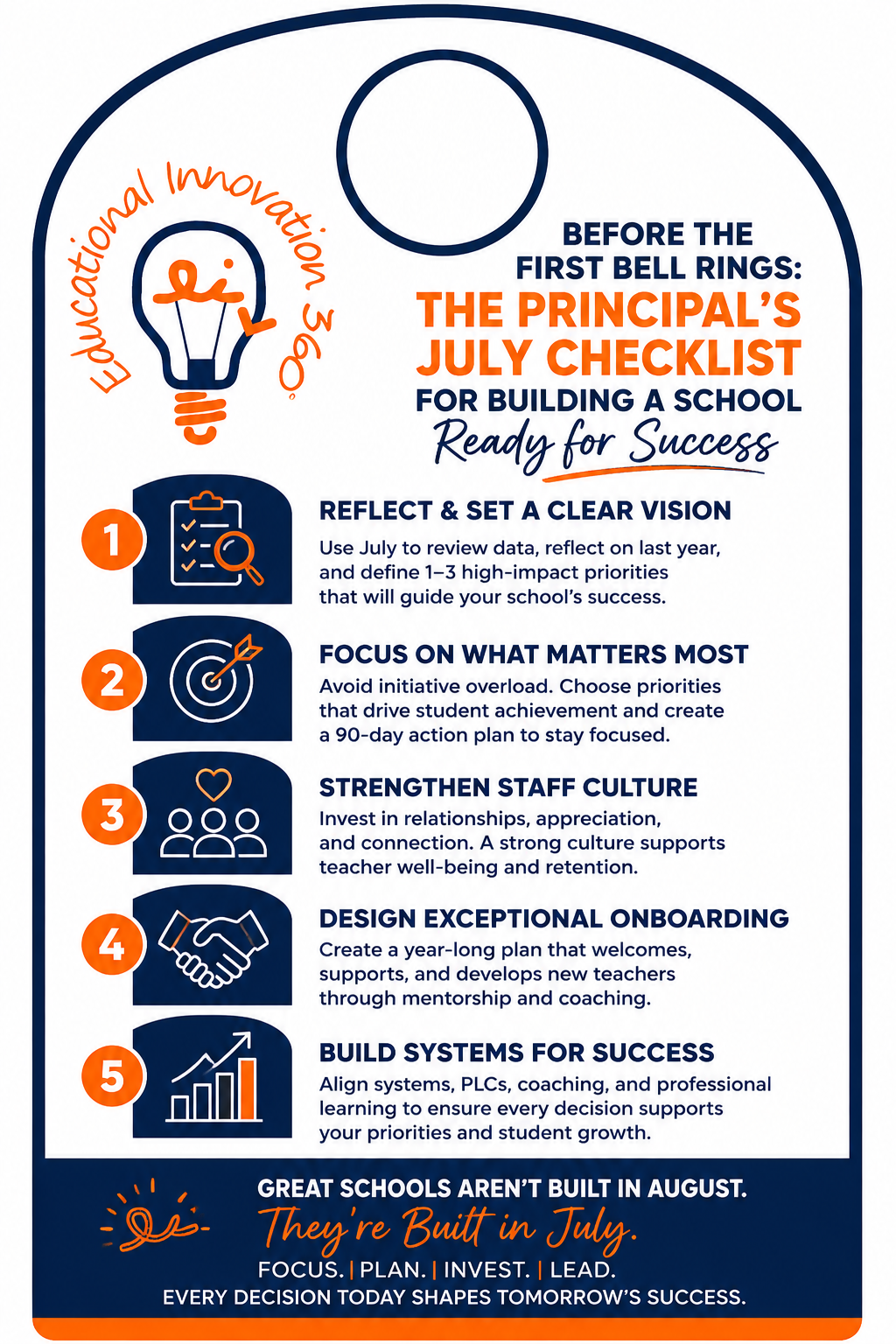
Ei360: Ready for Success
At Educational Innovation 360, we believe successful principals do not simply prepare for the first day of school. They prepare for the entire year. The following July checklist highlights five leadership priorities that can help principals create schools where educators thrive, students succeed, and continuous improvement becomes part of the culture.
Reflect, Refine, and Establish a Clear Instructional Vision
One of the greatest advantages of July is the opportunity to think without constant interruptions. During the school year, principals spend much of their day responding to immediate needs. Summer creates space to examine data, reflect on leadership practices, and determine where the school needs to go next (eSpark Learning, 2022; BetterLesson, 2024). Before developing new initiatives, begin by looking backward.
Review your school's academic performance, attendance data, discipline trends, staff survey results, and family feedback. Instead of asking whether the school had a good year, ask deeper leadership questions:
Which initiatives produced measurable results?
Where did student learning stall?
Which systems supported teachers effectively?
What barriers prevented progress?
Research consistently shows that principals who intentionally reflect on multiple data sources make stronger instructional decisions and create greater organizational coherence (Learning Policy Institute, 2023).
Focus on Fewer Priorities That Matter Most
One of the most common leadership mistakes is trying to improve everything at once. Schools often begin the year with numerous initiatives, multiple professional development topics, and competing priorities. Unfortunately, this approach frequently overwhelms teachers and dilutes instructional impact. Instead, identify one to three high-impact priorities that will guide every leadership decision throughout the year (Learning Policy Institute, 2023; Shultz, 2017).
For many schools, these priorities may include:
Strengthening Tier 1 literacy instruction
Improving mathematics achievement
Increasing teacher retention
Building culturally responsive classrooms
Improving attendance
Increasing ninth-grade on-track rates (Student Achievement Solutions, 2023)
After selecting your priorities, convert them into measurable goals supported by a practical 90-day action plan that guides work through August, September, and October (BetterLesson, 2024).
Educational Innovation 360 Leadership Insight
Great schools rarely suffer from a lack of ideas. They struggle from a lack of focus. When every initiative becomes a priority, nothing receives the attention necessary to create lasting improvement. Successful principals create clarity by helping every staff member understand what matters most and how their daily work contributes to those goals.
Reflection Questions
As you prepare for the school year, consider the following:
If every teacher described your school's priorities, would their answers be consistent?
Which instructional challenge deserves the greatest investment this year?
What evidence will demonstrate that your priorities are making a difference?
Example in Practice
Imagine an elementary principal reviewing spring assessment data and discovering that Grade 3 reading proficiency declined while teacher turnover increased. Rather than launching multiple disconnected initiatives, the principal identifies two priorities: improving early literacy and strengthening teacher support.
During July, the leadership team aligns professional learning, instructional coaching, PLC conversations, and mentoring around these two goals. Every meeting, classroom observation, and coaching conversation reinforces the same priorities, creating coherence across the school (Student Achievement Solutions, 2023; Learning Policy Institute, 2023). Intentional focus transforms summer planning into meaningful school improvement.
Strengthen Staff Culture and Design an Exceptional Onboarding Experience
The first experience teachers have with a school often shapes how they feel for the rest of the year. Unfortunately, onboarding is sometimes reduced to a single orientation session packed with information, forms, and logistics. Effective principals recognize that onboarding is not an event. It is a leadership strategy.
Research shows that teacher retention, instructional quality, and school culture are closely connected to how new educators are welcomed, supported, and developed (Learning Policy Institute, 2023; Student Achievement Solutions, 2023). July provides the ideal opportunity to build those systems intentionally instead of rushing through them during opening week (New Leaders, 2024).
Build a Year-Long Onboarding Experience
Rather than focusing only on the first day, create a structured onboarding plan that extends throughout the first 90 days. An effective onboarding experience should introduce teachers to:
Your instructional vision
Classroom expectations
Assessment practices
Technology platforms
Student support systems
School traditions
Key staff members
Family engagement expectations (Student Achievement Solutions, 2023)
Continue supporting new teachers with scheduled check-ins after 30, 60, and 90 days so they receive guidance as new challenges emerge (New Leaders, 2024).
Create Meaningful Coaching and Mentoring
Every new teacher deserves more than a friendly colleague down the hallway. Assign experienced mentors who understand that their role extends beyond answering questions. Effective mentors provide instructional guidance, co-plan lessons, observe classrooms, offer meaningful feedback, and serve as trusted thought partners throughout the year (Student Achievement Solutions, 2023).
Research indicates that structured mentoring programs improve teacher confidence, instructional effectiveness, and long-term retention more consistently than informal buddy systems (Learning Policy Institute, 2023).
Invest in Relationships Before the School Year Begins
Strong school cultures are built on relationships. July offers principals the opportunity to intentionally strengthen connections before the demands of the school year take over.
Consider organizing:
Leadership retreats
Grade-level planning sessions
Informal breakfasts
Team-building activities
Community service events
New teacher welcome gatherings
These experiences help educators develop trust and create a stronger sense of belonging before students arrive (Shultz, 2017; Learning Policy Institute, 2023).
Make Appreciation Part of Your Leadership System
Teacher appreciation should never become an afterthought reserved for Teacher Appreciation Week. The most effective principals build recognition into their leadership routines throughout the year.
Simple practices can have a meaningful impact:
Celebrate instructional successes during staff meetings.
Highlight innovative classroom practices in newsletters.
Send handwritten thank-you notes.
Recognize collaboration publicly.
Celebrate personal and professional milestones.
Consistent recognition strengthens morale, increases engagement, and reinforces the behaviors that contribute to a positive school culture (BetterLesson, 2025).
Educational Innovation 360 Leadership Insight
Culture is not created by posters on the wall. It is created by daily leadership behaviors. Teachers are more likely to remain in schools where they feel supported, valued, challenged, and connected to a shared mission. The work principals do in July lays the foundation for those relationships long before students arrive.
Reflection Questions
Consider these questions as you prepare your staff for a new year:
What will new teachers remember about their first week?
Does your mentoring program focus on compliance or professional growth?
How will teachers know their work is valued throughout the year?
Strong cultures do not happen by accident. They are intentionally designed by leaders who understand that investing in people is one of the highest-impact decisions they can make.
References
BetterLesson. (2024). School leadership strategies and instructional leadership resources. https://betterlesson.com
BetterLesson. (2025). Building positive school culture and teacher appreciation. https://betterlesson.com
eSpark Learning. (2022). Using student data to drive instructional decision making. https://www.esparklearning.com
Learning Policy Institute. (2023). The role of the principal in supporting instructional improvement and teacher retention. https://learningpolicyinstitute.org
New Leaders. (2024). Effective principal leadership: Supporting teachers through onboarding and coaching. https://www.newleaders.org
Shultz, T. (2017). The principal's guide to school leadership. Routledge.
Student Achievement Solutions. (2023). Leadership practices that improve student achievement. https://studentachievementsolutions.com