
When Experience Becomes a Liability: Why Veteran Teachers Are Being Labeled "Overqualified
Across the country, school districts are facing a painful contradiction. Schools continue to experience teacher shortages, yet many veteran educators are finding themselves overlooked for new opportunities, leadership roles, or even classroom positions because they are considered "too experienced," "too expensive," or "overqualified."
If you've ever wondered why years of dedication, advanced degrees, and proven results can suddenly become barriers instead of strengths, you're not alone.
The Teacher Shortage Paradox
America needs teachers. According to the Learning Policy Institute (2025), more than 411,000 teaching positions nationwide are either vacant or staffed by under-certified educators. Additionally, nearly one in eight teaching positions is currently filled by someone who lacks full certification or remains unfilled altogether (Learning Policy Institute, 2025; Edustaff, 2026).
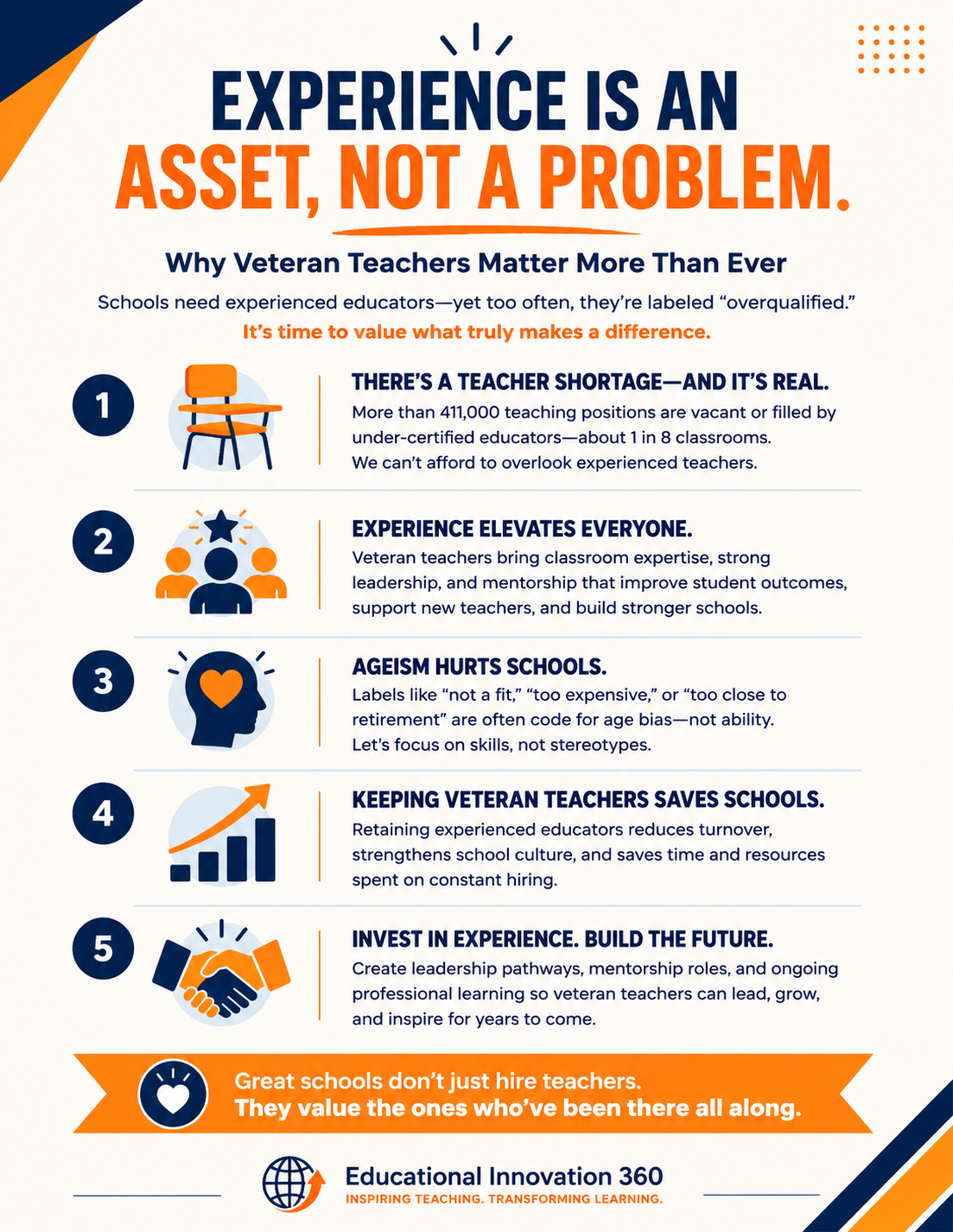
At the same time, many highly experienced educators struggle to secure positions or advancement opportunities. How can both of these realities exist simultaneously? The answer may lie in an uncomfortable truth: ageism and misconceptions about experience are quietly influencing educational hiring practices.
The Hidden Meaning Behind "Overqualified"
For many educators, the word "overqualified" doesn't actually mean too skilled.
Instead, it often translates to:
Too expensive.
Too experienced.
Too close to retirement.
Too likely to question ineffective practices.
Too knowledgeable to accept poor working conditions.
Research suggests that hiring decisions in education are frequently influenced by perceptions of "fit," financial considerations, and informal assumptions about experience (Goldhaber et al., 2014; Papay & Kraft, 2016). Unfortunately, those assumptions can negatively impact veteran educators.
How Ageism Shows Up in Schools
Age discrimination in education is rarely obvious.
Instead, it often appears through coded language:
"We're looking for someone energetic."
"We need someone innovative."
"We want a digital native."
"You're probably looking for something more."
Veteran teachers frequently report being labeled as resistant to change or lacking technological skills despite years of evidence demonstrating otherwise. Educational author Pernille Ripp (2011) noted that experienced educators are often no longer viewed as "experienced" but simply as "old." This shift in perception can have serious consequences for teacher morale and career opportunities.
Experience Matters More Than Ever
The irony is that schools need veteran educators now more than ever. Research consistently shows that experienced teachers contribute to:
Stronger classroom management
Improved student outcomes
Higher levels of instructional expertise
Better mentoring for novice teachers
Greater school stability
The UCLA Civil Rights Project (2025) found that experienced teachers play a particularly important role in supporting students in high-poverty communities and schools serving historically marginalized populations. Experience is not a liability; it is an asset.
Why Teachers Are Leaving
Teacher attrition continues to drive the majority of hiring demand. According to the Learning Policy Institute (2025), approximately 90% of annual teacher demand results from educators leaving the profession, not from increases in student enrollment.
Teachers cite several reasons for leaving:
Inadequate compensation
Poor working conditions
Lack of respect
Limited professional support
Burnout
Feeling undervalued
Many mid-career and veteran educators also point to being "priced out" or excluded from leadership opportunities because of their years of experience. When experienced educators leave, schools lose more than employees. They lose institutional knowledge, mentorship, and instructional expertise.
The Cost of Losing Veteran Teachers
When districts fail to value experienced educators, everyone loses.
Students lose:
Highly skilled instruction
Stability and consistency
Strong relationships
Access to teacher mentors and leaders
New teachers lose:
Coaching and support
Practical wisdom from seasoned educators
Models of effective instruction
Schools lose:
Leadership capacity
Cultural knowledge
Community connections
Professional expertise
Teacher shortages cannot be solved by continuously replacing experienced educators with underprepared staff.
Where Teachers Are Going
Many educators are choosing to take their talents elsewhere. Former teachers are increasingly moving into careers such as:
Instructional design
Corporate training
Educational consulting
Curriculum writing
Educational technology
Nonprofit leadership
Higher education
Project management
These professions often view years of teaching experience as a tremendous advantage rather than a drawback (Hershbein, 2025). The education sector should ask itself an important question:
If other industries value educators' expertise, why don't schools always do the same?
What Schools Should Be Doing Instead
1. Value Experience as an Investment
Veteran educators bring tremendous value to school systems. Districts should move away from viewing experienced teachers solely through a budget lens and instead recognize the long-term impact they have on student achievement.
2. Create Leadership Pathways
Schools should intentionally create roles for experienced educators, including:
Instructional coaches
Mentor teachers
Teacher leaders
Residency mentors
Professional learning facilitators
Strong mentoring programs significantly improve teacher retention and support novice educators (Learning Policy Institute, 2025).
3. Invest in Ongoing Professional Learning
Professional development should be available to educators at every stage of their careers.
Veteran teachers deserve opportunities to:
Develop new technology skills
Lead innovation initiatives
Explore emerging instructional practices
Continue growing professionally
Experience and innovation are not opposites. The best schools intentionally cultivate both.
A Message to Veteran Teachers
If you've ever been told you're "overqualified," remember this:
Your experience matters. Your knowledge matters. Your years of service matter. The relationships you've built, the students you've impacted, and the wisdom you've gained cannot be replaced. Education needs experienced educators who are willing to mentor, lead, and continue learning alongside the next generation of teachers. At Educational Innovation 360, we believe that great schools are built by honoring both innovation and experience. Sustainable school improvement doesn't happen by pushing veteran educators aside; it happens when we leverage their expertise to strengthen teaching and learning for everyone.
The future of education depends not only on attracting new teachers but also on ensuring that our most experienced educators know they are still deeply valued. Because in education, experience should never be considered "overqualified." It should be considered indispensable.
Ei360: We have a teacher shortage problem… but we also have an experience problem. Across the country, more than 411,000 teaching positions are vacant or filled by under-certified educators. Yet many veteran teachers are being labeled as "overqualified," "too expensive," or "not a culture fit."
References
Edustaff. (2026). Teacher shortages in 2025: What the data revealed and what 2026 will demand.
Goldhaber, D., Krieg, J., Theobald, R., & Brown, N. (2014). Teacher effectiveness and the teacher pipeline.
Hershbein, B. (2025). What do teachers do when they leave teaching? Brookings Institution.
Learning Policy Institute. (2025). An Overview of Teacher Shortages.
Papay, J. P., & Kraft, M. A. (2016). The changing labor market for teachers.
Ripp, P. (2011). The Emerging Age Bias. Edutopia.
UCLA Civil Rights Project. (2025). Barriers to Racial Equity for Teachers of Color and Indigenous Teachers in California's Teaching Pipeline and Profession.