
What Instructional Coaches Are Really Doing During the Summer
Summer often creates a misconception in education. Once students leave and classrooms quiet down, many assume instructional coaches step away from their responsibilities until August. The reality is quite different. Highly effective instructional coaches understand that summer is one of the most important seasons of the year. It provides an opportunity to recharge, reflect, learn, strengthen relationships, and strategically prepare for the challenges ahead.
While the pace may slow, the work of building coaching capacity and instructional leadership continues. The most successful coaches use the summer months intentionally. They balance personal restoration with professional growth, ensuring they return ready to support teachers and improve student outcomes.
Recharging Is Professional Work
Instructional coaching is demanding work. Coaches spend much of the school year supporting teachers through instructional challenges, curriculum implementation, data analysis, and professional growth. They frequently serve as mentors, facilitators, problem-solvers, and trusted thought partners. Because coaching is deeply relational, it requires significant emotional and professional energy.
Summer provides an important opportunity to restore that energy. Effective coaches understand that stepping away from daily responsibilities is not a sign of disengagement. Rather, it is a critical component of long-term effectiveness (CT3 Education, 2024; Reflect to Learn, 2020). Whether through travel, hobbies, exercise, family activities, or simply enjoying a slower pace, coaches who prioritize personal renewal are often better equipped to support others when the school year begins.
Leadership Reflection
School leaders should recognize that sustainable coaching requires sustainable people. Coaches who enter August refreshed and energized are far more likely to provide high-quality support than those who begin the year already exhausted.
Investing in Professional Learning
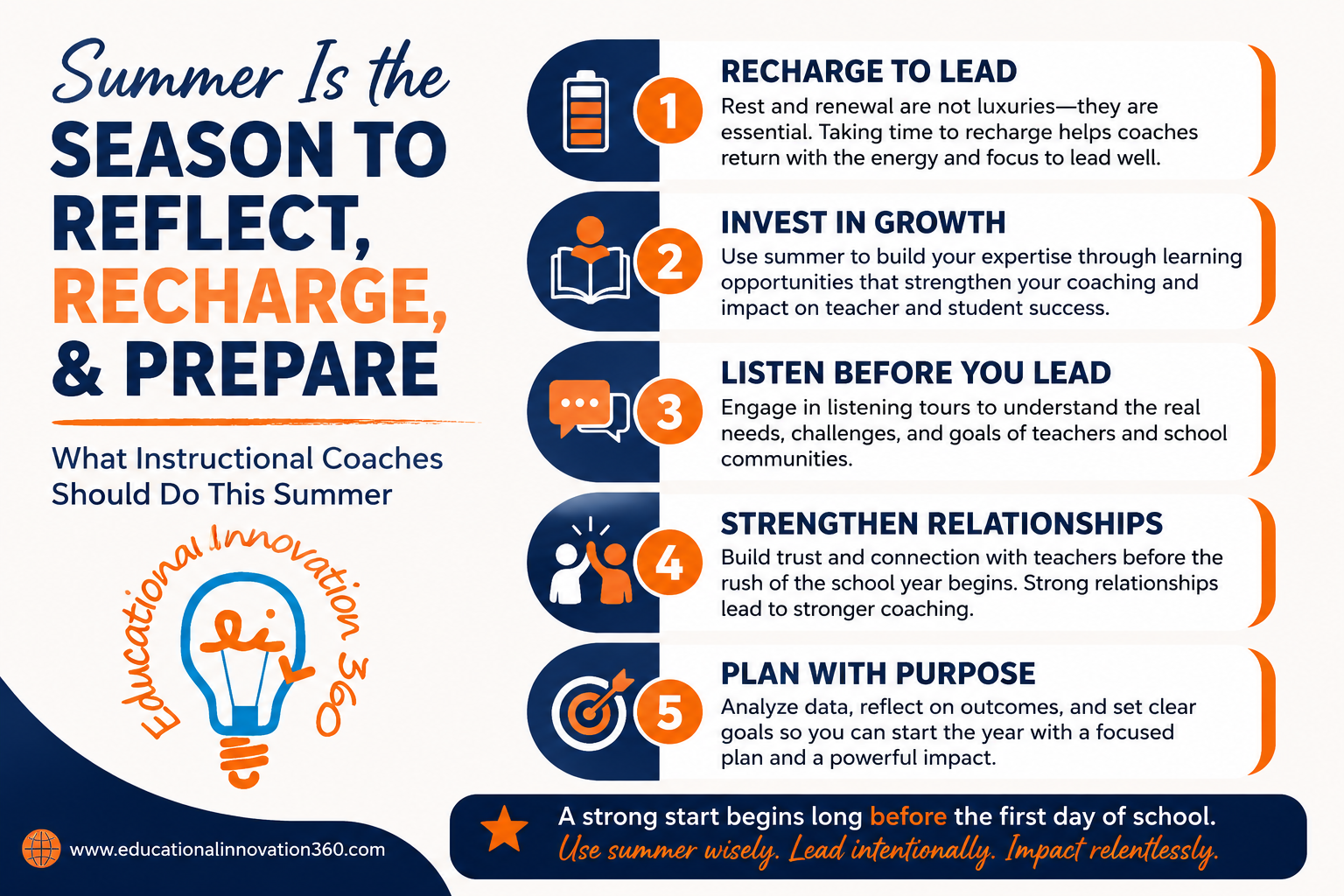
Ei360: Summer is the Season to reflect
While rest matters, summer also provides a unique opportunity for focused professional growth. During the school year, professional learning often competes with urgent responsibilities. Summer creates space for deeper learning and reflection. Many coaches participate in conferences, leadership academies, workshops, and instructional leadership programs designed to strengthen their coaching expertise (Relay Graduate School of Education, 2025).
Common areas of focus include:
Instructional leadership
Coaching conversations
Adult learning theory
Data-informed decision making
Equity-centered instructional practices
Curriculum and assessment design
This commitment to learning matters because coaching effectiveness directly influences classroom practice. Research examining teacher coaching found significant positive effects on instructional quality and student achievement when coaching is implemented effectively (Kraft et al., 2018). Summer allows coaches to sharpen the very skills that will drive teacher growth throughout the year.
Listening Before Leading
One of the most powerful things coaches can do during the summer is listen. Many successful instructional coaches use this time to conduct formal or informal listening tours. These conversations may include teachers, administrators, support staff, students, families, and community stakeholders (CT3 Education, 2024). The purpose is not to introduce new initiatives. The purpose is to understand. Listening tours help coaches identify:
Persistent instructional challenges
Professional learning needs
Teacher concerns
School culture issues
Barriers to implementation
By gathering input before the school year begins, coaches can design support systems that address real needs rather than perceived ones. More importantly, listening builds trust. Teachers are far more likely to engage in coaching when they believe their voices have been heard and valued.
Leadership Implication
Instructional coaching should never be built on assumptions. Summer listening creates the foundation for responsive coaching that aligns with school and district priorities.
Strengthening Relationships Before the First Day
Trust remains the currency of effective coaching. Without trust, feedback feels evaluative. Conversations become guarded. Growth slows. Summer offers a valuable opportunity to strengthen relationships before instructional challenges emerge. Many coaches intentionally reach out to teachers through thank-you notes, brief check-ins, text messages, or informal conversations that focus on connection rather than work responsibilities (Reflect to Learn, 2020).
These interactions communicate a simple but powerful message: "You matter beyond what happens in your classroom." When teachers experience that level of support, coaching relationships often become stronger, more authentic, and more productive. The strongest coaching relationships are rarely built during difficult conversations. They are built long before those conversations become necessary.
Planning for the Year Ahead
Summer also creates the mental space necessary for strategic thinking. Rather than reacting to immediate challenges, coaches can analyze data, reflect on previous outcomes, and identify priorities for the upcoming year. This proactive approach helps coaches focus their time and resources where they will have the greatest impact (CT3 Education, 2024).
Strategic planning often includes:
Reviewing student achievement data
Analyzing coaching outcomes from the previous year
Identifying teachers who may need early support
Establishing measurable coaching goals
Aligning coaching plans with school improvement initiatives
Mapping professional learning opportunities
This preparation allows coaches to begin the year with clarity and purpose rather than scrambling to respond to emerging needs.
A Question for Leaders
How often do we provide coaches with dedicated time to think strategically rather than simply react operationally? The answer to that question often determines the long-term effectiveness of a coaching program.
Building Systems That Create Capacity
Exceptional coaching requires more than expertise. It requires systems. Summer is often the ideal time for coaches to develop and refine organizational structures that support their work throughout the year. This includes creating coaching calendars, observation schedules, feedback protocols, communication systems, and data-tracking processes (CT3 Education, 2024).
Strong systems accomplish two important goals. First, they increase efficiency. Second, they ensure coaching efforts remain aligned with priorities and measurable outcomes. When organizational systems are established before the school year begins, coaches spend less time managing logistics and more time supporting instruction. For districts seeking to maximize coaching impact, system development should be viewed as an essential component of the coaching role rather than an administrative afterthought.
Supporting Summer Learning Programs
Many instructional coaches extend their influence during the summer by supporting summer school programs, teacher academies, and educator preparation initiatives. These experiences provide opportunities to coach in highly focused environments where feedback cycles occur rapidly and learning is accelerated (Teacher Accelerator Program, 2025; The Breakthrough Collaborative, 2022).
In these settings, coaches often:
Facilitate professional development
Conduct classroom observations
Support lesson planning
Provide instructional feedback
Build collaborative learning communities
Working alongside novice educators and teacher candidates helps coaches refine their own facilitation skills while contributing to the development of future teachers. The experience benefits everyone involved.
Preparing Resources and Learning Environments
Another important summer responsibility involves preparing the tools and resources that will support coaching throughout the year. Coaches frequently spend time:
Updating coaching materials
Revising observation tools
Organizing professional learning resources
Developing protocols and templates
Preparing coaching spaces
These tasks may seem routine, but they contribute significantly to coaching effectiveness (CT3 Education, 2024). A well-organized environment communicates professionalism, readiness, and a commitment to teacher success. It also reduces unnecessary distractions once the school year begins.
Summer Is Not a Pause. It Is a Launchpad.
The most effective instructional coaches understand that summer is neither a vacation from leadership nor an extension of the school year's relentless pace. It is a season of intentional preparation. They rest so they can sustain their work. They learn so they can better support teachers. They listen so they can lead responsively. They plan so they can focus on what matters most. When coaches use the summer strategically, they return with renewed energy, stronger skills, deeper relationships, and a clearer vision for impact (CT3 Education, 2024; Reflect to Learn, 2020). For principals, district leaders, and coaching coordinators, the message is clear: supporting coaches during the summer is an investment in the entire instructional system. The work that happens during June and July often shapes the success of the entire school year.
Great coaches are build in the Off-season
References
CT3 Education. (2024, March 7). 10 things great coaches do over the summer. https://www.ct3education.com/10-things-great-coaches-summer/
Kraft, M. A., Blazar, D., & Hogan, D. (2018). The effect of teacher coaching on instruction and achievement: A meta-analysis of the causal evidence. Review of Educational Research, 88(4), 547-588. https://doi.org/10.3102/0034654318759268
Reflect to Learn. (2020, July 7). How coaches make the most of summer. https://www.reflecttolearn.com/post/how-coaches-make-the-most-of-summer
Relay Graduate School of Education. (2025). Instructional leadership professional development. https://www.relay.edu/professional-education/leadership-programs/instructional-leadership-professional-development
Teacher Accelerator Program. (2025). Instructional coach job description: TAP summer. https://teacheraccelerator.org/
The Breakthrough Collaborative. (2022). Breakthrough instructional coach programs nationwide. https://www.breakthroughcollaborative.org/