
Building and Retaining a Diverse Teaching Workforce: A Principal's Action Guide
Why Teacher Diversity Matters More Than Ever
Across the United States, student demographics continue to diversify, yet the educator workforce remains disproportionately White. While students of color represent more than half of the public school population, teachers of color account for only about one-fifth of the teaching workforce (Carver-Thomas, 2018). This disparity presents both a challenge and an opportunity for school leaders.
Research consistently demonstrates that teacher diversity positively impacts student achievement, engagement, graduation rates, and college enrollment. Students who have teachers who share their racial or ethnic background experience improved academic outcomes and stronger connections to school (Gershenson et al., 2017). Additionally, diverse teaching staffs expose all students to multiple perspectives, helping them develop cultural competence and preparing them to thrive in an increasingly interconnected society (Villegas & Irvine, 2010).
For principals, building a diverse teaching workforce is not simply a diversity initiative, it is a school improvement strategy that directly impacts student success.
Strategic Recruitment: Expanding the Talent Pipeline
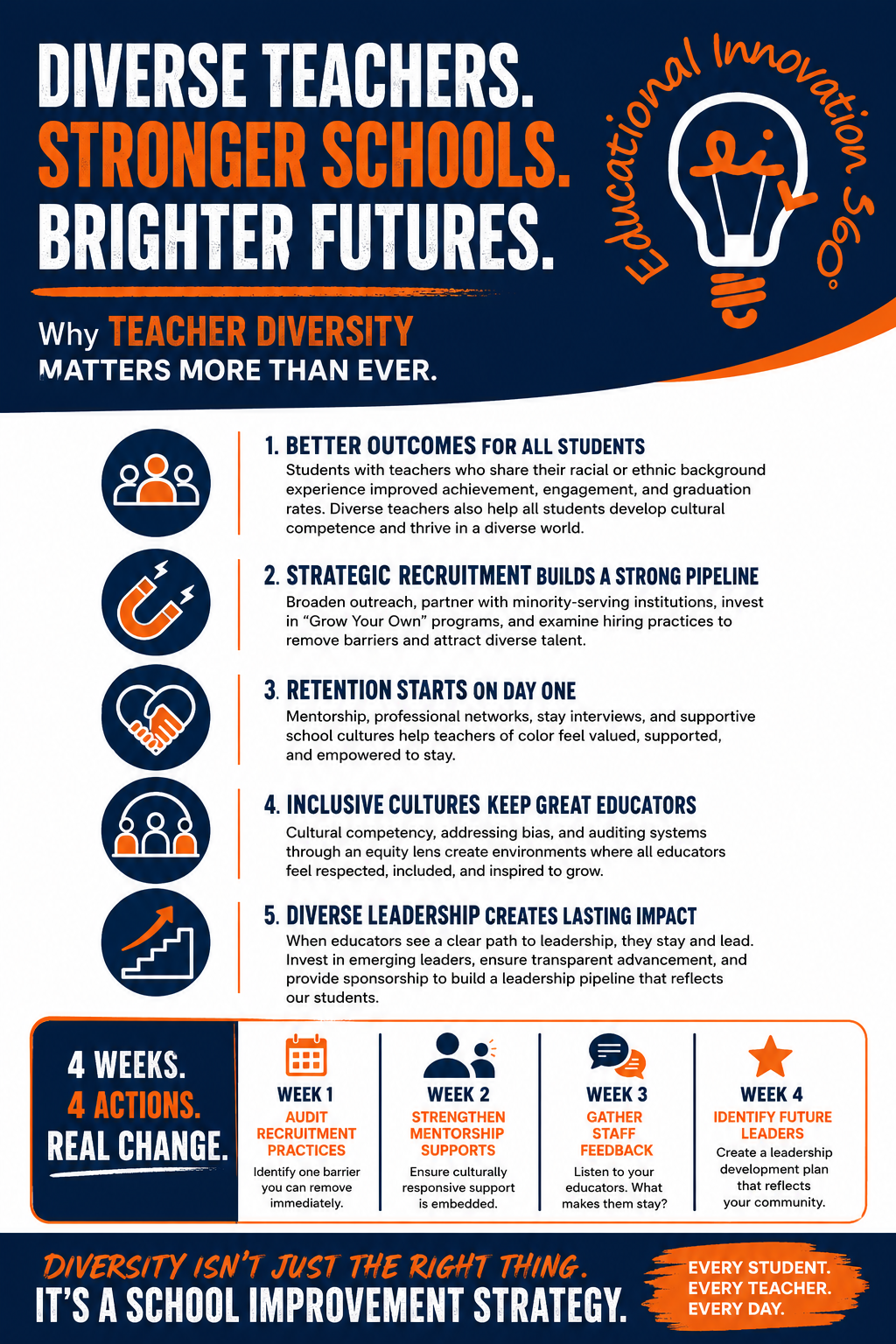
Ei360: Diverse Talent, Stronger Schools, Brighter Futures.
Many districts rely on traditional recruitment methods that unintentionally limit access to diverse talent pools. Principals can take a more intentional approach by broadening recruitment efforts and building long-term partnerships.
Practical Recruitment Strategies
1. Partner with Minority-Serving Institutions
Develop relationships with Historically Black Colleges and Universities (HBCUs), Hispanic-Serving Institutions (HSIs), Tribal Colleges, and universities with strong educator preparation programs. Consider:
Hosting student teachers
Offering internship opportunities
Participating in campus recruitment events
Creating early hiring commitments for promising candidates
2. Develop “Grow Your Own” Programs
Many future educators already exist within your community. Grow Your Own initiatives can identify and support the following:
High school students interested in education careers
Paraprofessionals seeking teacher certification
Substitute teachers pursuing licensure
Community members who reflect local demographics
Research indicates that locally developed educators are often more likely to remain in the district long-term (Carver-Thomas, 2018).
3. Examine Hiring Practices for Hidden Barriers
Principals should review hiring procedures to identify practices that may unintentionally disadvantage candidates from underrepresented groups. Questions to consider:
Are interview panels diverse?
Are the evaluation criteria standardized?
Are job descriptions emphasizing essential qualifications?
Are candidates asked culturally responsive interview questions?
Structured interviews and standardized rubrics help reduce unconscious bias and promote equitable hiring decisions (Ingersoll et al., 2019).
Retention Starts on Day One
Recruitment alone is not enough. Nationally, teachers of color leave the profession at higher rates than their White peers, often citing isolation, lack of support, and unsupportive school cultures as primary reasons for departure (Kohli, 2018).
Practical Retention Strategies
1. Create Comprehensive Mentorship Programs
New teachers benefit from strong mentorship, but teachers of color often need additional support navigating workplace dynamics and cultural challenges. Effective mentorship programs should:
Match new teachers with trained mentors
Provide regular coaching sessions
Include discussions about school culture and belonging
Offer support beyond instructional practices
Mentors do not necessarily need to share the same racial identity but should demonstrate cultural competence and a commitment to equity.
2. Establish Professional Networks and Affinity Groups
Many educators of color report feeling isolated within predominantly White schools. Voluntary affinity groups can provide opportunities for
Professional collaboration
Emotional support
Leadership development
Networking across schools or districts
These communities foster belonging and contribute to higher retention rates (Partee, 2014).
3. Conduct Stay Interviews
Principals often conduct exit interviews when teachers leave. A more proactive approach is conducting stay interviews.
Ask questions such as:
What makes you want to stay at our school?
What barriers are impacting your success?
How can leadership better support you?
These conversations provide valuable insights before retention challenges become resignations.
Building an Inclusive School Culture
School culture plays a significant role in teacher satisfaction and retention. Educators are more likely to remain in environments where they feel respected, valued, and included.
Practical Leadership Actions
1. Prioritize Cultural Competency Learning
Professional development should move beyond one-time workshops and become an ongoing component of school improvement efforts.
Effective professional learning includes:
Examining implicit bias
Understanding culturally responsive teaching
Analyzing equity data
Practicing inclusive communication strategies
Sustained professional learning communities create deeper and more lasting change than isolated training sessions.
2. Address Microaggressions and Bias Promptly
Research indicates that hostile racial climates contribute significantly to teacher attrition among educators of color (Kohli, 2018).
Principals should:
Establish clear reporting procedures
Respond promptly to concerns
Model respectful communication
Hold staff accountable for inclusive practices
Silence often communicates acceptance. Leadership action communicates commitment.
3. Audit School Systems Through an Equity Lens
Principals should regularly examine:
Discipline practices
Advanced course enrollment
Staff leadership opportunities
Family engagement efforts
Professional development participation
Systemic inequities often influence both student outcomes and teacher experiences. Addressing these issues creates healthier environments for everyone.
Developing Diverse Leadership Pathways
Teachers are more likely to remain in organizations where they see opportunities for growth and advancement. Research suggests that principals of color are more likely to recruit and retain teachers of color, creating a positive cycle of representation and inclusion (Ingersoll et al., 2019).
Strategies for Leadership Development
1. Identify Emerging Leaders Early
Look beyond traditional leadership candidates and intentionally identify educators from diverse backgrounds who demonstrate leadership potential.
Provide opportunities such as:
Leading professional learning communities
Serving on district committees
Facilitating staff development
Participating in leadership academies
2. Create Transparent Advancement Processes
Teachers should clearly understand how to pursue leadership opportunities.
Questions principals should consider:
Are leadership opportunities publicly communicated?
Are the selection criteria clearly defined?
Do leadership teams reflect the diversity of the student population?
Transparency increases access and promotes equity.
3. Invest in Sponsorship, Not Just Mentorship
While mentors provide guidance, sponsors actively advocate for opportunities for advancement.
Principals can serve as sponsors by:
Recommending educators for leadership roles
Encouraging graduate study
Connecting teachers with professional networks
Providing stretch assignments that build leadership skills
Four Actions Principals Can Take This Month
Building a diverse workforce requires sustained commitment, but meaningful progress begins with small, intentional actions.
Week 1: Audit Recruitment Practices: Review hiring procedures and identify one barrier that can be removed immediately.
Week 2: Strengthen Mentorship Supports: Evaluate current induction programs and ensure culturally responsive support is embedded throughout the process.
Week 3: Gather Staff Feedback: Conduct listening sessions or stay interviews to understand how educators experience school culture.
Week 4: Identify Future Leaders: Create a leadership development plan that intentionally supports educators from underrepresented backgrounds.
Final Thoughts
Building and retaining a diverse teaching workforce is not a short-term initiative; it is a long-term commitment to educational excellence. Diverse educators improve academic outcomes, strengthen school culture, and prepare students to succeed in a multicultural world. As principals, the question is no longer whether diversity matters. The evidence is clear. The real question is: What systems, supports, and opportunities are we creating to ensure talented educators from all backgrounds choose our schools and stay? Schools that prioritize diversity, equity, belonging, and leadership development will be better positioned to attract exceptional educators and create learning environments where every student can thrive.
References
Bristol, T. J., & Goings, R. B. (2019). Exploring the boundary-heightening experiences of Black male teachers: Lessons for teacher education programs. Journal of Teacher Education, 70(1), 51–64.
Carver-Thomas, D. (2018). Diversifying the teaching profession: How to recruit and retain teachers of color. Learning Policy Institute.
Gershenson, S., Hart, C. M. D., Lindsay, C. A., & Papageorge, N. W. (2017). The long-run impacts of same-race teachers (IZA Discussion Paper No. 10630). Institute of Labor Economics.
Ingersoll, R., May, H., & Collins, G. (2019). Recruitment, employment, retention and the minority teacher shortage. Education Policy Analysis Archives, 27(37), 1–37.
Kohli, R. (2018). Behind school doors: The impact of hostile racial climates on urban teachers of color. Urban Education, 53(3), 307–333.
Partee, G. L. (2014). Retaining teachers of color in our public schools: A critical need for action. Center for American Progress.
Villegas, A. M., & Irvine, J. J. (2010). Diversifying the teaching force: An examination of major arguments. The Urban Review, 42(3), 175–192.