
Using Mid-Year Data as a Strategic Pivot: How Principals Can Change the Trajectory of Student Outcomes
Mid-year assessment results usually show up right when everyone is feeling the "winter slump." Between tight pacing guides and the general fatigue of the mid-year stretch, it’s tempting to treat these scores as just another box to check before filing them away. But when we treat data as a chore rather than a tool, we miss out on a huge opportunity to support our students.
Here’s the good news: mid-year data is actually a superpower for pivoting. When principals frame these scores as a helpful GPS for the rest of the year, rather than a "grade" on a teacher’s performance, it opens up the door to refocus instruction and get resources exactly where they’re needed most while there’s still plenty of time to make a difference (Wayman et al., 2012; New Leaders, 2023). Done right, these reviews don't just improve test scores; they build a supportive, "we're-in-this-together" culture where everyone is focused on growing.
Reframing Mid-Year Scores as a Decision Point
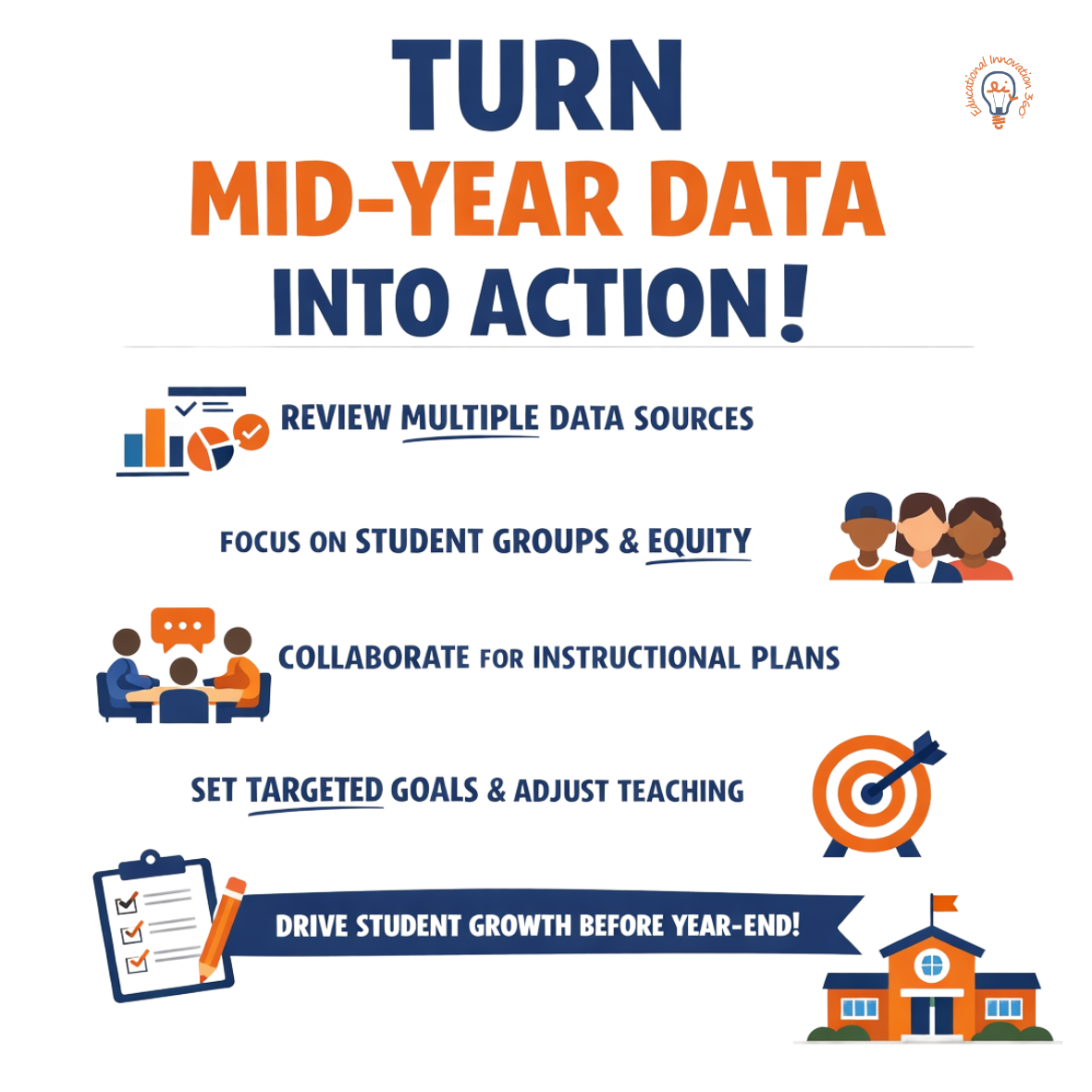
Ei360: Turn Mid-Year Data Into Action
Think of mid-year assessments as a "check-in" rather than a "final grade." Because they happen right in the middle of the action, they give us a great chance to see how students are doing and adjust our game plan while there’s still plenty of time to help them grow (NWEA, n.d.).
One of the most important things we’ve learned is that the vibe around data really matters. When we use these scores as a tool to help us improve, instead of a way to point fingers, teachers feel much more comfortable getting creative and trying new strategies (Ellevation Education, 2022; Wayman et al., 2012). On the flip side, if data talks feel like a performance review, it’s only natural for people to get defensive, which makes it harder to actually help the kids.
For principals, it’s all about setting a supportive tone from the start. Instead of asking, “Who is responsible for these low scores?” the conversation should be, “How can we tweak our teaching and support systems to help our students win?” Leading with that kind of mindset creates a safe space where everyone feels like they’re on the same team, working toward the same goal.
Key Trends in Data Use for School Leadership
When it comes to using school data, the "old way" of doing things is staring at one big spreadsheet once a semester, is out. Instead, effective school leaders are moving toward a more holistic, ongoing approach that feels a lot more like a team sport than a math test.
Here are the big trends making a difference right now:
Looking at the Whole Picture: Rather than obsessing over a single test score, schools are mixing and matching different types of info. They’re looking at interim results alongside things like attendance, classroom work, and even how students are behaving (NCEO, 2021). It’s like looking at a whole puzzle instead of just one piece; it keeps us from overreacting to one bad day and helps us see the real patterns.
Making it a Habit, Not a "Day": High-performing schools have ditched the dreaded "Data Day" in favor of quick, regular check-ins (SOLVED Consulting, 2025). When you look at data every couple of weeks, making tweaks to your teaching becomes a normal part of the routine, not a stressful emergency.
Focusing on What Actually Helps in Class: Not all data is created equal. The best leaders focus on information that actually tells a teacher what to do on Monday morning (NCIEA, 2025). If the data doesn't help you decide how to teach a specific standard better, it’s probably just noise.
Building Your "Data Muscles" Together: We’ve found that teachers are much more likely to use data when they feel confident and supported (Nebraska Department of Education & REL Central, 2021). That’s why so many schools are investing in PLCs (Professional Learning Communities) and coaching. It’s all about building that collective "data literacy," so no one feels like they’re crunching numbers alone.
At the end of the day, these mid-year scores are most powerful when they’re part of a living, breathing system of learning rather than just a lonely benchmark on the calendar.
How Principals Use Data Differently
When we look at how the most effective principals handle data, a few really cool leadership patterns start to stand out. It’s less about being a "math person" and more about being a great detective and a supportive coach. Here is how top-tier leaders are making it work:
Looking at the Big Picture: Instead of just looking at one classroom at a time, great principals zoom out to see the whole school. They use mid-year scores to ask the big questions: Are our resources going to the right places? Is our schedule actually working? Are we making sure every group of students is getting what they need? (Wayman et al., 2012). It's about making sure the "business side" of the school supports the "learning side."
Connecting the Dots: They know that numbers never tell the whole story. If reading scores dip, they don't just jump to conclusions; they look at the "why" by checking in on school spirit, attendance, or maybe a recent change in the curriculum (New Leaders, 2023). It’s about mixing the hard data with the real-life "vibe" of the hallways.
Making it Part of the Routine: The best data use happens when it isn't a special event. These principals bake data talks right into meetings that are already happening, such as PLCs or grade-level check-ins (Wayman et al., 2012). When data is just a regular part of the conversation, it stops feeling scary and becomes a helpful tool for everyday teaching.
Best Practices for Conducting Mid-Year Data Reviews
Turning mid-year scores into action requires intentional design. The following research-aligned practices support principals in leading effective mid-year reviews. To wrap things up, here’s a friendly "roadmap" for making those mid-year reviews really count. It’s all about moving from "looking at numbers" to "making a plan" in a way that feels supportive and clear.
1. Get Clear on Your Goals
Before you even open a spreadsheet, remind everyone what the finish line looks like. If you don't have a specific mid-year goal yet, you can work backward from your end-of-year targets to figure out where students should be right now (HMH, 2025). Focus on a few simple questions: Are we on track? What’s working well? Who needs an extra boost?
2. Use a "Mixed Bag" of Info
Try to keep your data formats consistent so they’re easy to read, but don't rely on just one test (NWEA, n.d.). By looking at test scores alongside daily classroom work and attendance, you get the full story (NCEO, 2021). It prevents us from overreacting to one "off day" and helps us make smarter choices.
3. Make it a Team Effort
Data is way more useful when we talk about it together! Instead of having teachers look at scores alone, set up dedicated time for teams to chat using a simple "What? So what? Now what?" protocol (Wayman et al., 2012). This turns data from a "gotcha" into a shared mission.
4. Zoom from Big to Small
Start with the big picture (how is the whole school doing?) and then zoom in until you're looking at individual students. This helps you move from general observations to actual plans—like starting a specific reading group or offering an enrichment project—rather than just saying we’ll "try harder."
5. Link it Straight to the Classroom
Data is only helpful if it changes what happens on Monday morning. Use your results to pick which standards need a "redo" and which students are ready for a challenge (NCIEA, 2025). When teachers know exactly which skills to focus on, the path forward feels a lot less overwhelming (HMH, 2025).
6. Keep Equity at the Heart
Take a close look at how different groups of students are doing. This isn't about finding fault; it’s about making sure our schedule and resources are actually fair (NCEO, 2021). When we use mid-year data to get the right help to the right kids, we build a lot of trust with our community.
7. Build Confidence and Trust
At the end of the day, people use data when they feel like they’re good at it and they know they won't be punished for what the numbers show (Nebraska Department of Education & REL Central, 2021). Celebrate the wins, model how to read the charts, and always use the data to ask: "How can I support you better?"
From Data to Action: A Practical Mid-Year Cycle
Think of the mid-year process as a continuous loop that keeps the school moving in the right direction. It’s not just a one-time meeting; it’s a leadership cycle that keeps everyone aligned and supported.
The Mid-Year Leadership Cycle
To make this work, try following these simple steps:
Prepare and Frame: Start by reminding everyone why we’re doing this. It’s all about the goals we set for our students at the start of the year.
Analyze at Every Level: Look at the data from the whole-school view down to individual student needs using reports that everyone recognizes.
Select Focused Priorities: Don’t try to fix everything at once. Pick a few "high-leverage" standards, the ones that will make the biggest difference for your students right now.
Align Supports: Make sure the help follows the need. Whether it's extra tutoring, new materials, or coaching, put your resources where the data says they’ll help most.
Monitor and Revisit: Don’t wait for the end of the year! Check back in every 4–6 weeks to see if the changes you made are actually working.
The Bottom Line
When you lead mid-year reviews this way, those scores stop being scary numbers on a report and start being a strategic lever that can actually change the path of a student’s learning journey.
Remember: Mid-year scores are not a verdict. They are an invitation. When you accept that invitation with clear goals, a solid structure, and a lot of trust, you turn data into real momentum for your school.
References
Debra Durma Consulting. (2025, January 19). What to do during mid-year data review?
Ellevation Education. (2022, December 31). The power of data-driven decision-making in schools.Houghton Mifflin Harcourt. (2025, December 3). Using assessment data to inform instruction.
National Center for the Improvement of Educational Assessment. (2025, July 7). Assessment data masquerading as instructionally useful information.
National Center on Educational Outcomes. (2021). Using multiple measures of academic achievement to inform instructional decisions (MIDAS Report 101).
Nebraska Department of Education & REL Central. (2021). How Nebraska teachers use and perceive summative, interim, and formative data (REL 2021–054).
New Leaders. (2023, November 13). Data-driven instruction: What is a school leader’s role?
NWEA. (n.d.). Using assessment data to shape instruction [White paper].
SOLVED Consulting. (2025, May 27). Build a data-driven school district: 5 proven strategies.
Wayman, J. C., Spring, D., Lemke, M., & Lehr, M. (2012). Using data to inform practice: Effective principal leadership strategies.